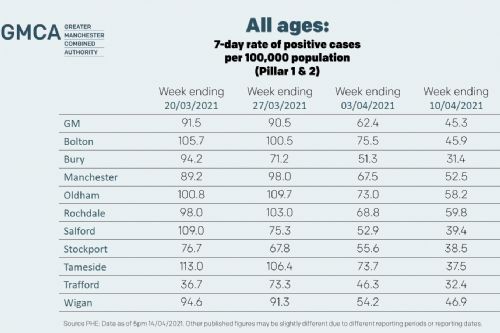
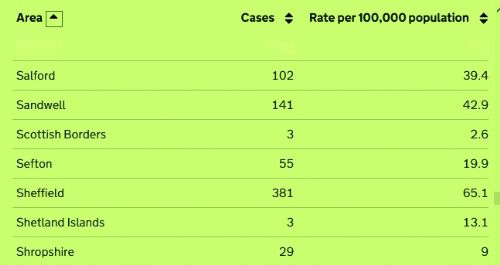
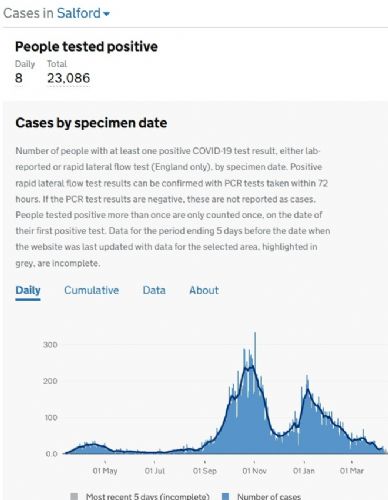
Salford has 8 new coronavirus cases, down from the previous day's 12, which brings the cumulative total of cases to 23,086. The seven day average of cases in Salford is now 102, down from 104, while the seven day rate per 100,000 population now stands at 39.4, down from 40.2.
Elsewhere in Greater Manchester, the seven day average of cases in Bury is 60 (down from 62), with a seven day rate per 100,000 population of 31.4 (down from 32.5); Bolton 133 (down from 145), with a rate of 46.3 (down from 50.4); Manchester 295 (up from 281), with a rate of 53.4 (up from 50.8); and Oldham 143 (same), with a rate of 60.3 (same).
Rochdale has a seven day average of cases of 133 (down from 139), with a seven day rate of 59.8 (down from 62.5); Stockport 113 (down from 119), with a rate of 38.5 (down from 40.6); Tameside 85 (down from 87), with a rate of 37.5 (down from 38.4); Trafford 81 (up from 78), with a rate of 34.1 (up from 32.9); and Wigan 154 (down from 155), with a rate of 46.9 (down from 47.2).
There have been no new virus-related deaths announced by Salford Royal Hospital, as hospital data for all hospitals in Greater Manchester more or less are showing improvement.
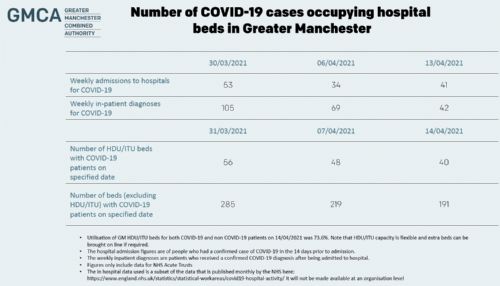
The number of weekly admissions for COVID-19 and in-patient diagnosis has fallen from 103 on 6th April, to 83 on 13th April, while the number of COVID patients in GM hospitals has fallen from 219 on 7th April, to 191 on 14th April. The number of COVID patients in intensive care has also fallen from 48 to 40 during the same period.
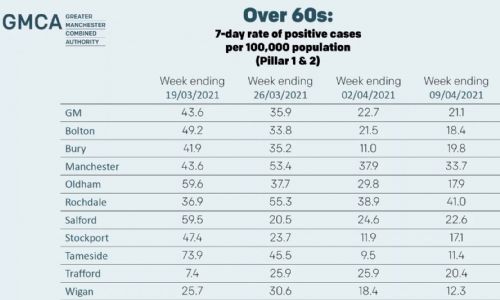
Meanwhile, the seven day rate of cases in the over 60s per 100,000 population has dropped to 22.6 in Salford for the week ending 9th April, from 59.5 on 19th March. The current rate for all ages in Salford is 39.4.
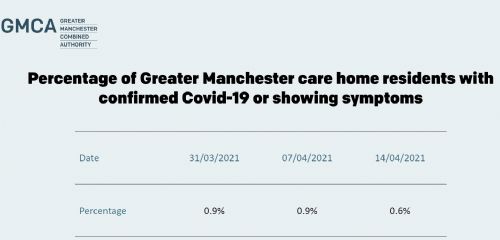
In Greater Manchester care homes the percentage of residents with either COVID-19 or showing symptoms has fallen to 0.6% on 14th April, down from 0.9% on 7th April.
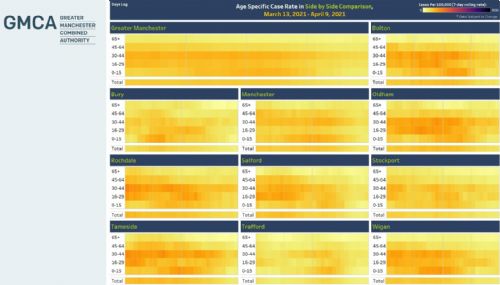
The highest prevalence of COVID-19 at the moment is in the 30-44 age group, and the number of cases in the 30 to 64 age group are expected to increase as lockdown eases.
Commenting on the figures, GM Health Lead Richard Leese says that as the COVID-19 case numbers drop, small numbers can have an influence on the percentages. He adds that vaccinations have had a real impact on transmission and the number of infections, and that hospitals should be back to operating on full cylinders in June, although the backlog will take two to three years to clear.
Main graphic shows an age heat map of Greater Manchester cases




.jpg)


.jpg)
.jpg)
(3).jpeg)
.png)
(1).JPG)
