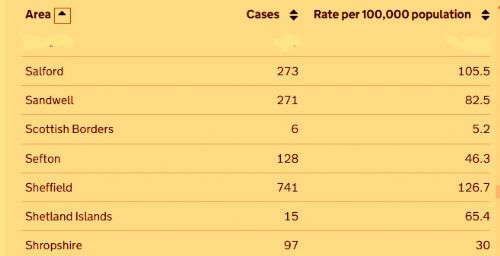
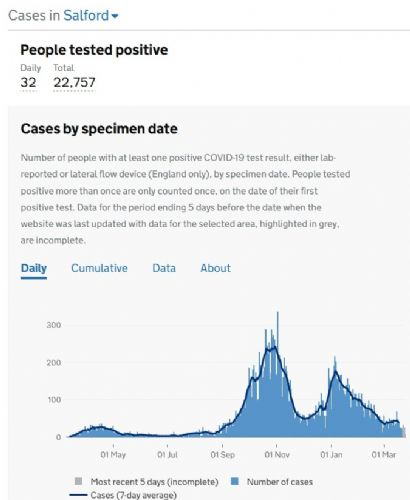
Salford has 32 new coronavirus cases, down from the previous day's 34, bringing the cumulative total to 22,757. The seven day average of cases in Salford is now 273, down from 286, while the seven day rate per 100,000 population now stands at 105.5, down from 110.5.
Elsewhere in Greater Manchester, the seven day average of cases in Bury is 184 (down from 186), with a seven day rate per 100,000 population of 96.3 (down from 97.4); Bolton 311 (up from 310), with a rate of 108.2 (up from 107.8); Manchester 504 (up from 484), with a rate of 91.2 (up from 87.5); and Oldham 254 (up from 239), with a rate of 107.1 (up from 100.8).
Rochdale has a seven day average of cases of 222 (up from 219), with a seven day rate of 99.8 (up from 98.5); Stockport 220 (down from 229), with a rate of 75 (down from 78); Tameside 274 (up from 257), with a rate of 121 (up from 113.5); Trafford 104 (up from 90), with a rate of 43.8 (up from 37.9); and Wigan 339 (up from 323), with a rate of 103.1 (up from 98.3).
Since 13th March testing for the virus has doubled for most boroughs of Greater Manchester, with Salford carrying out 6,798 tests during the week of 6th March, rising to 11,717 tests in the following week, with 11,189 tests during the week ending 20th March. While testing has doubled, largely due to schools and colleges testing students, positive virus cases have only risen very slightly and cases are significantly down compared to February.
There have been no new virus-related deaths announced by Salford Royal Hospital.
COVID-19 admissions and in-patient diagnosis in Greater Manchester hospitals have significantly fallen, from 215 on 15th March, to 154 on 22nd March. The number of hospital beds occupied by COVID patients has also decreased, from 365 on 16th March, to 309 on 23rd March, while the number of COVID patients in intensive care has fallen, from 77 to 66 during this period.
The percentage of Greater Manchester care home residents with COVID-19 or showing symptoms has decreased slightly from 1.8% to 1.5% during the same period.
1,171,054 doses of vaccine have now been administered in Greater Manchester, covering 93% of over 70s, 77% of those age 50 to 69, and 26% of those in the 18 to 49 age bracket, making a total of 53% of the population.


.PNG)
.PNG)
.PNG)
.PNG)
.PNG)
.PNG)


.jpg)


.jpg)
.jpg)
(3).jpeg)
.png)
(1).JPG)
