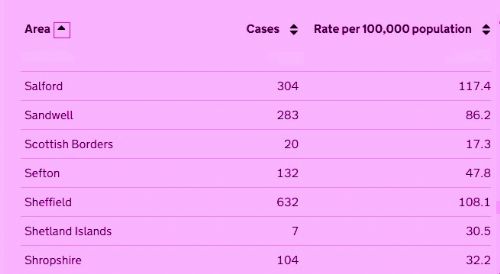
Salford has 45 new coronavirus cases, up from the previous day's 43, bringing the cumulative total to 22,610. The seven day average of cases in Salford is now 304, down from 306, while the seven day rate per 100,000 population now stands at 117.4, down from 118.2..
Elsewhere in Greater Manchester, the seven day average of cases in Bury is 160 (down from 162), with a seven day rate per 100,000 population of 83.8 (down from 84.8), Bolton 297 (up from 288), with a rate of 103.3 (up from 100.2); Manchester 535 (up from 531), with a rate of 96.8 (up from 96); and Oldham 245 (up from 241), with a rate of 103.3 (up from 101.6).
Rochdale has a seven day average of cases of 255 (down from 272), with a seven day rate of 114.7 (down from 122.3); Stockport 261 (down from 271), with a rate of 89 (down from 92.4); Tameside 276 (up from 274), with a rate of 121,9 (up from 121); Trafford 105 (down from 109), with a rate of 44.2 (down from 45.9); and Wigan 342 (down from 352), with a rate of 104.1 (down from 107.1).
There have been no new virus-related deaths announced by Salford Royal Hospital.
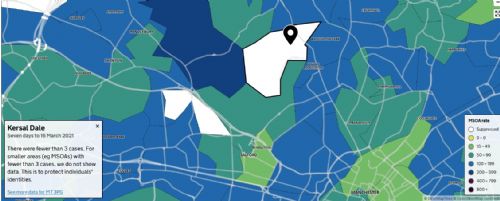
Meanwhile, the latest Government interactive map of seven day rolling rates of infection per 100,000 population up to 16th March shows three areas of Salford with less than three cases of the virus – Kersal Dale, Walkden North East and Lightoaks.
Other areas with low infection rates include Pendleton, with 3 cases and a rolling rate of 45.5, and Walkden North West, 3 cases and a rate of 48.7.
Only one area, Clifton Green and Pendlebury East, has a rolling rate of infection over 300.
Most areas in the city have rates between 100 and 199, and between 50 and 99.
To view the full map click here and enter a postcode





.jpg)


.jpg)
.jpg)
(3).jpeg)
.png)
(1).JPG)
