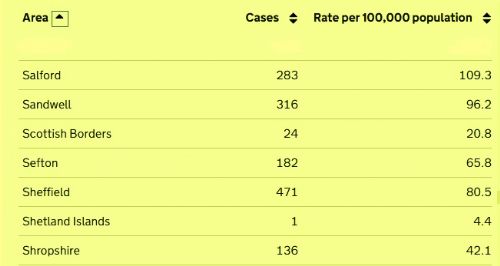
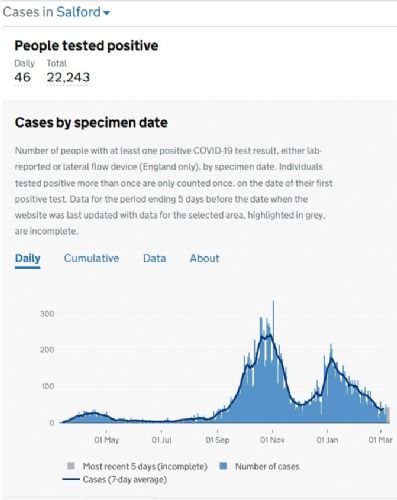
Salford has 46 new coronavirus cases, up from the previous day's 42, bringing the cumulative total to 22,243. The seven day average of cases in Salford is now 283, up from 257, while the seven day rate per 100,000 population has now crept back over 100 and stands at 109.3, up from 99.3.
Elsewhere in Greater Manchester, the seven day average of cases in Bury is 163 (up from 161), with a seven day rate per 100,000 population of 85.3 (up from 84.3); Bolton 274 (down from 285), with a rate of 95.3 (down from 99.1); Manchester 435 (up from 422), with a rate of 78.7 (up from 76.3); and Oldham 194 (down from 195), with a rate of 81.8 (down from 82.2).
Rochdale has a seven day average of cases of 262 (up from 259), with a seven day rate of 117.8 (up from 116.5); Stockport 237 (down from 241), with a rate of 80.8 (down from 82.1); Tameside 235 (down from 238), with a rate of 103.8 (down from 105.1); Trafford 140 (up from 133), with a rate of 59 (up from 56); and Wigan 315 (down from 327), with a rate of 95.8 (down from 99.5).
There have been no new virus-related deaths at Salford Royal Hospital, and up to 8th March, 92,355 vaccinations had been carried out across the city.
Meanwhile, a new survey of over 1,500 teaching assistants, cleaners, technicians, librarians, receptionists and catering staff in the North West by trade union, UNISON, shows major concerns about the return to schools this week. The vast majority think the 'big bang' reopening of schools was a mistake, with 75% favouring a phased or staggered return.
35% were worried school ventilation systems, which generate air flow to combat airborne transmission of the virus, aren't up to the job and 34% hadn't seen their school's risk assessment or received an individual safety check. A further 88% think school workers should be given priority access to the jab, but only one third have had the vaccine so far, despite 44% being in clinically vulnerable or in a high-risk group, and 4% so vulnerable they're shielding.
55% backed the use of year group rotas to free up space for proper social distancing, and 49% supported staff and pupils wearing face covering in corridors, classrooms and offices.
"Children need to be back in school, but the justifiable fears of support staff need to be heard and addressed too" says UNISON North West schools organiser Keith Bradley "The North West continues to have some of the areas with the highest levels of COVID-19 in the country.
"It's shocking that a third of school staff still haven't had a risk assessment and simple safety measures, such as adopting a rota system to help social distancing, have been ruled out by ministers" he adds.
"The Government needs to take account of the specific vulnerabilities of support staff and encourage schools to conduct detailed individual risk assessments to identify those at increased risk" he explains "Clinically vulnerable workers must be allowed to work from home until the virus risk is reduced or until they're vaccinated. Untold damage will be done if ministers don't put education and safety first and roll out the vaccine to all school staff."
The Salford Star reported yesterday how at least three schools in the city have sent pupils home to self-isolate (see here), while a group called Parents United UK is both a forum for concerned parents and is trying to track confirmed cases in schools.
Parents United also has a 'traffic lights' map of local authority cases - see here - and it believes that any area with an nfection rate above 50 should have all schools closed apart from for key workers children and vulnerable children. Salford is coloured dark red on the map with a case rate of 116.3, very high.
Parents United UK does have an interactive map but cases date back to last September – click here
For more details on Parents United UK see the Facebook group – click here





.jpg)


.jpg)
.jpg)
(3).jpeg)
.png)
(1).JPG)
