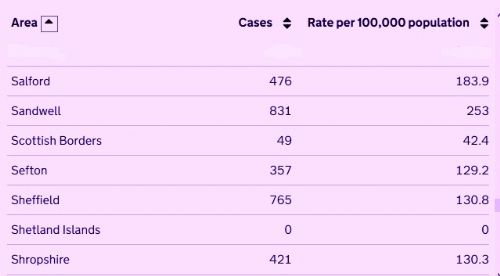
Salford has 60 new coronavirus cases, up from the previous day's 38, bringing the cumulative total to 21,576. The seven day average of cases in Salford has decreased to 476, down from 515, while the seven day rate per 100,000 population now stands at 183.9, down from 199.
Elsewhere in Greater Manchester, the seven day average of cases in Bury is 444 (up from 421), with a seven day rate per 100,000 population of 232.5 (up from 220.4); Bolton 645 (down from 658), with a rate of 224.3 (down from 228.8); Manchester 942 (down from 957), with a rate of 170.4 (down from 173.1); and Oldham 365 (down from 383), with a rate of 153.9 (down from 161.5).
Rochdale has a seven day average of cases of 381 (same), with a seven day rate of 171.3 (same); Stockport 514 (down from 516), with a rate of 175.2 (down from 175.9); Tameside 435 (down from 448), with a rate of 192.1 (down from 197.8); Trafford 293 (down from 312), with a rate of 123.4 (down from 131.4); and Wigan 574 (up from 558), with a rate of 174.6 (up from 169.8).
.
There have been three new virus-related deaths at Salford Royal Hospital. At the Greater Manchester Leaders' press conference yesterday, it was shown that weekly admissions to hospitals in the region and in-patient diagnosis of the virus have fallen from 524 in the week ending 15th February, to 430 on 22nd February.
The total number of beds with COVID patients in Greater Manchester hospitals has also fallen, from 771 on 16th February, to 617 on 23rd February, and COVID patients in intensive care beds fell slightly from 147 to 140 during the same period. Meanwhile, the percentage of care home residents with COVID or COVID symptoms has remained stable at 1.9% on 23rd February, the same as the previous week.
GM Health Lead, Richard Leese, said that, as a result of the pressure easing on the NHS, the Nightingale hospital at GMex will be stood down at the end of March.
As of 23rd February, a total of 737,248 people in Greater Manchester, or 34% of adults, had received their first vaccine jab, including 91% of over 70 year olds, 37% of 50 to 69 year olds and 14% of 18 to 49 year olds. In Salford, latest data shows that 45,020 doses of the vaccines have been administered at the three community hubs and outreach sites.
Salford has now also done over 11,500 rapid tests for people who can't work from home and have no symptoms, and over one hundred have tested positive. To get tested – click here
Richard Leese and GM Mayor, Andy Burnham, called for more flexibility in the vaccination programme to ensure that spare capacity, particularly at the Etihad mass vaccination centre, is used to immunise those in high risk occupations, such as bus drivers and teachers who are over 50.
Leese pointed out the inefficiency of having two separate streams of booking vaccinations – local and national... "We ought to be able to join up those two streams at the local level as that would enable us with the required flexibilities to make sure we use all the capacity we've got most effectively."
There was a concern amongst GM Leaders that virus cases in Greater Manchester are not coming down fast enough, and this was thought to be caused by the 'volatility' of the new strains and the vast numbers of people having to go to work in the region..."Our most recent survey shows that over sixty per cent of the working age population are still having to go to work" said Leese "And that's quite often in circumstances where it's hard to avoid mixing with other people."
Andy Burnham added that while leaders "are concerned about the case rate in the North West" it was being driven by factors like people not being able to afford to self-isolate without proper support, and people frightened of losing their jobs if they take time off work. An estimated thousand people in Greater Manchester cannot self-isolate because of these factors, and he called for the Government to fix the issues in the budget.
Meanwhile, Burnham approved the Government's "cautious, phased approach" to the release of lockdown and added that the roadmap "feels like our voice has been heard...the approach is right but the risks remain very high indeed" he said referencing that the case rate is much higher than when the first lockdown was lifted.
He concluded by saying that the context this time is very different from when previous lockdowns have been lifted, as there is a vaccination programme in place and there are evidenced stages of release... "It's a very different picture with different factors at play" Burnham said, while welcoming "the light at the end of the tunnel"...


.jpg)

.jpg)
.jpg)
.jpg)
.jpg)
.jpg)
.jpg)
.jpg)
.jpg)


.jpg)


.jpg)
.jpg)
(3).jpeg)
.png)
(1).JPG)
