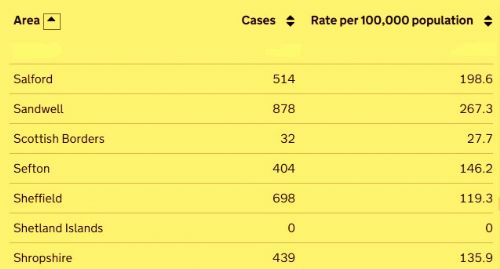
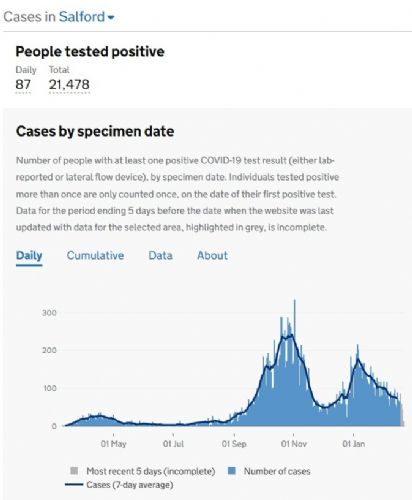
Salford has 87 new coronavirus cases, up from the previous day's 64, bringing the cumulative total to 21,478. The seven day average of cases in Salford has decreased to 514, down from 530, while the seven day rate per 100,000 population now stands at 198.6, down from 204.8.
Elsewhere in Greater Manchester, the seven day average of cases in Bury is 427 (up from 413), with a seven day rate per 100,000 population of 223.6 (up from 216.2); Bolton 663 (up from 648), with a rate of 230.6 (up from 225.4); Manchester 1,037 (up from 1,014), with a rate of 187.6 (up from 183.4); and Oldham 400 (down from 403), with a rate of 168.7 (down from 170).
Rochdale has a seven day average of cases of 374 (down from 408), with a seven day rate of 168.2 (down from 183.4); Stockport 511 (down from 528), with a rate of 174.2 (down from 179.9); Tameside 472 (down from 477), with a rate of 208.4 (down from 210.6); Trafford 315 (up from 300), with a rate of 132.7 (up from 126.4); and Wigan 568 (same), with a rate of 172.8 (same).
.
There has been one new virus-related death at Salford Royal Hospital.
Meanwhile, the full re-opening of all schools and colleges on 8th March has been met with scorn by teachers' union, the National Education Union, or NEU, with Joint General Secretary, Dr Mary Bousted saying that it demonstrates, again, that Boris Johnson has, despite all his words of caution, failed to learn the lessons of his previous mistakes.
"Whilst cases of COVID infection are falling, along with hospitalisation rates, it remains the case, unfortunately, that cases are three times higher now than when schools re-opened last September" she explains.
"This fact, alone, should have induced caution rather than, in the words of Nadhim Zahawi an 'ambitious' school return which runs the risk of schools, once again, becoming, in the Prime Minister's words on 4 January, a 'vector of transmission' into the community" she adds "This risk is greatly elevated because of the new variants of COVID which are significantly more transmissive.
"Why has the English Government not taken the same route as Scotland, Wales or Northern Ireland, whose cautious, phased approach to school opening will enable their governments to assess the impact a return to the classroom will have on the R rate and to make necessary adjustments to their plans" she asks.
"A 'big bang' school reopening brings ten million people back into crowded buildings with no social distancing and inadequate ventilation" she says "The wearing of face masks by pupils and staff in secondary school lessons is a welcome measure but it is not, on its own enough.
"The Government has had two months to put extra mitigations in place to stop the growth in infection in schools that was seen from September to December" she adds "Where are the ventilation units for classrooms? Where are the nightingale classrooms? Where is the PHE testing which school leaders could rely upon to give more accurate results? It is no good political parties talking about these safeguards when they know very well that they have not been put in place and will not be put in place by 8 March. Words are cheap. Actions are needed.
"The Government must publish the science and the modelling which informs their unique school return plan" she says "It should also make plans to protect vulnerable and older education staff who should be supported to work from home until their vaccinations take effect.
"While schools and colleges will, as always, go the extra mile, headteachers should have been given the flexibility offered in the other nations to plan for a phased school return" she concludes "It would have been far better to take that time to plan and implement a successful and sustainable wider opening – which today's announcement does not, unfortunately, guarantee."
For Salford MPs' reactions and the reaction of the GM Mayor to yesterday's Government 'roadmap' announcement, and further details see previous Salford Star article – click here





.jpg)


.jpg)
.jpg)
(3).jpeg)
.png)
(1).JPG)
