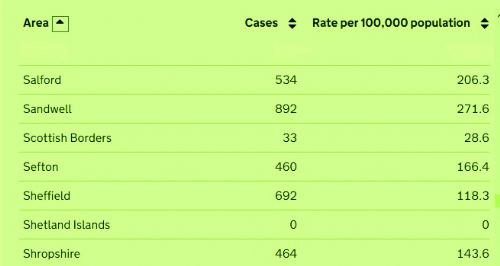
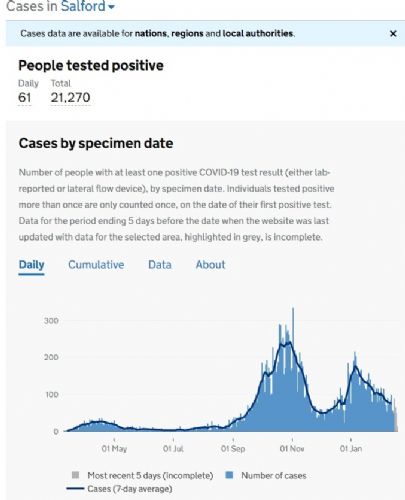
Salford has 61 new coronavirus cases, down from the previous day's 63, bringing the cumulative total to 21,270. The seven day average of cases in Salford has decreased to 534, down from 537, while the seven day rate per 100,000 population now stands at 206.3, down from 207.5.
Elsewhere in Greater Manchester, the seven day average of cases in Bury is 391 (up from 387), with a seven day rate per 100,000 population of 204.7 (up from 202.6); Bolton 666 (down from 679), with a rate of 231.6 (down from 236.1); Manchester 1,022 (down from 1,026), with a rate of 184.9 (down from 185.6); and Oldham 430 (down from 446), with a rate of 181.4 (down from 188.1).
Rochdale has a seven day average of cases of 385 (down from 396), with a seven day rate of 173.1 (down from 178); Stockport 540 (down from 545), with a rate of 184 (down from 185.7); Tameside 446 (up from 437), with a rate of 196.0 (up from 192.9); Trafford 326 (down from 328), with a rate of 137.3 (down from 138.2); and Wigan 575 (down from 577), with a rate of 175 (down from 175.6).
.
There have been five new virus-related deaths at Salford Royal Hospital.
Meanwhile, the Medicines and Healthcare products Regulatory Agency, or MHRA, has published its latest findings on COVID vaccine side effects for both the Pfizer/BioNTech and Oxford University/AstraZeneca jabs. It has a 'Yellow Card' scheme under which the public or health professionals can report any suspected side effects (see the website – click here).
"The nature of Yellow Card reporting means that reported events are not always proven side effects" states the MHRA "Some events may have happened anyway, regardless of vaccination. This is particularly the case when millions of people are vaccinated, and especially when most vaccines are being given to the most elderly people and people who have underlying illness."
Up to 7th February, 24,207 Yellow Cards had been reported for the Pfizer/BioNTech vaccine and 20,428 for the Oxford University/AstraZeneca vaccine, with 113 reports not mentioning any vaccine brand.
"For both vaccines, the overwhelming majority of reports relate to injection-site reactions (sore arm for example) and generalised symptoms such as 'flu-like' illness, headache, chills, fatigue (tiredness), nausea (feeling sick), fever, dizziness, weakness, aching muscles, and rapid heartbeat" states the MHRA "Generally, these happen shortly after the vaccination and are not associated with more serious or lasting illness.
"These types of reactions reflect the normal immune response triggered by the body to the vaccines" it adds "They are typically seen with most types of vaccine and tend to resolve within a day or two. The nature of reported suspected side effects is broadly similar across age groups, although, as was seen in clinical trials and as is usually seen with other vaccines, they may be reported more frequently in younger adults."
24,207 Yellow Cards for the Pfizer/BioNTech vaccine and 20,428 for the Oxford University/AstraZeneca vaccine works out at around one in every three hundred doses, or three or four for every thousand doses, given that around 7.5million Pfizer/BioNTech vaccines and 5million Oxford University/AstraZeneca vaccines have been administered.
The MHRA explains that the statistic "is not unusual for a new vaccine for which members of the public and healthcare professionals are encouraged to report any suspected adverse reaction".
It adds that "common side effects for both vaccines can occur at a rate of more than one in 10 doses (for example, local reactions or symptoms resembling transient flu-like symptoms)." Meanwhile, severe reactions are only reported in around one in every 100,000 doses administered.
The MHRA has also received 173 reports of suspected adverse reactions (ADRs) to the Pfizer/BioNTech vaccine in which the patient died shortly after vaccination, 150 reports for the Oxford University/AstraZeneca vaccine and 3 where the brand of vaccine was unspecified.
"The majority of these reports were in elderly people or people with underlying illness" the MHRA states "...however, this does not indicate a link between vaccination and the fatalities reported. Review of individual reports and patterns of reporting does not suggest the vaccine played a role in the death."
The MHRA concludes that "The number and nature of suspected adverse reactions reported so far are not unusual in comparison to other types of routinely used vaccines"; and that "Based on current experience, the expected benefits of both COVID-19 vaccines in preventing COVID-19 and its serious complications far outweigh any known side effects"...
To read the full report – click here




.jpg)


.jpg)
.jpg)
(3).jpeg)
.png)
(1).JPG)
