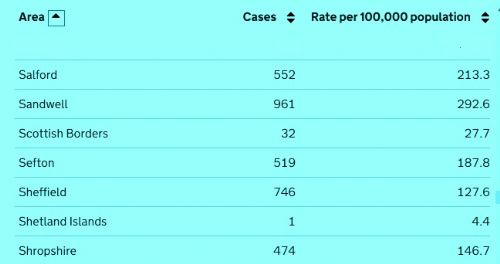
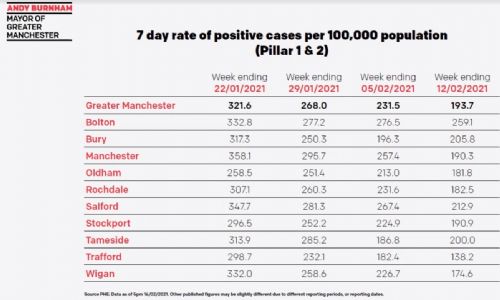
Salford has 86 new coronavirus cases, up from the previous day's 72, bringing the cumulative total to 21,146. The seven day average of cases in Salford has increased to 552, up from 547, while the seven day rate per 100,000 population now stands at 213.3, up from 211.3.
Elsewhere in Greater Manchester, the seven day average of cases in Bury is 393 (down from 394), with a seven day rate per 100,000 population of 205.8 (down from 206.3); Bolton 746 (down from 775), with a rate of 259.4 (down from 269.5); Manchester 1,055 (down from 1,064), with a rate of 190.8 (down from 192.5); and Oldham 431 (up from 425), with a rate of 181.8 (up from 179.2).
Rochdale has a seven day average of cases of 406 (down from 432), with a seven day rate of 182.5 (down from 194.2); Stockport 560 (up from 553), with a rate of 190.9 (up from 188.5); Tameside 454 (up from 443), with a rate of 200.4 (up from 195.6); Trafford 331 (up from 320), with a rate of 139.5 (up from 134.8); and Wigan 575 (down from 581), with a rate of 175 (down from 176.8).
.
There have been four new virus-related deaths at Salford Royal Hospital.
At yesterday's Greater Manchester Leaders' press conference, Greater Manchester Mayor, Andy Burnham, highlighted how infection rates in the region are declining at a slower rate than in other parts of the country and are still above the England average.
"This has been a feature of the pandemic" he said "because of the endemic nature of the virus in some of our communities and some of the inequalities that we experience...I think it's very much linked to work and the fact that in many of the communities of Greater Manchester a higher percentage of people have been out at work right throughout the pandemic because they have to.
"...And, of course, many of those people when they return home in the evening will return to housing where it's harder for people to self-isolate. Those two factors, work and housing, we believe, more than any other factor, explain why we have that higher case rate."
Related to this, he added, is the issue of workplace safety where the regulations are "quite loose" anyway; but in recent days the Health and Safety Executive has classified COVID-19 as a 'significant workplace risk', rather than a 'serious workplace risk'...
"We don't believe that is the right judgement" said Burnham, recalling that the Health and Safety Executive (HSE) hasn't been 'active partners' in managing workplace outbreaks. He called on the Government to ask HSE to re-consider its position and to classify the virus as a 'serious workplace risk'. He also repeated his call for a more substantial self-isolation support scheme.
Given that Greater Manchester does have high infection rates, and the new strains of virus are creating what Burnham called a "volatile situation", he has asked the Government to implement a "cautious national phased approach" to releasing lockdown, rather than tiers, after the opening of schools and allowing grass roots junior sport.
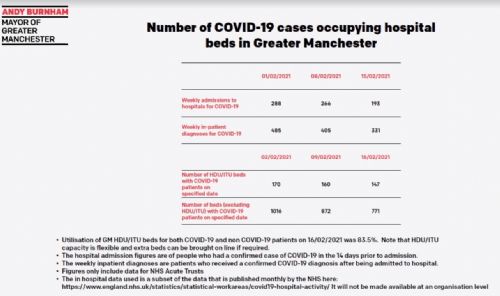
Meanwhile, it is better news in Greater Manchester as the pressure on hospitals seems to be easing with 524 weekly COVID admissions to hospitals and in-patient diagnoses on 15th February, compared to 671 the previous week.
The number of COVID patients in Greater Manchester hospital beds has also dropped from 872 on 8th February, to 771 on 16th February, while the number of those in intensive care beds has also dropped from 160 to 147 during that period. 17% of total beds in Greater Manchester are now taken up by COVID patients compared to 30% a few weeks ago.
While the NHS is fighting to save people, within the community people are still flouting the rules on virus safety, with Beverley Hughes, GM Deputy Mayor for Policing and Crime, revealing that there had been an increase in the public reporting COVID breaches and more resistance to the police.
In the seven days to Monday 15th February, the police dealt with 1,205 COVID incidents and issued 228 Fixed Penalty Notices (FPN), the majority over the weekend. Since August, over 3,500 FPNs have been issued.
"We're seeing a resurgence of very large gatherings" she said, adding that 55 £800 FPNs were issued in the last seven days, including one for a gathering in Salford and a large works party in an industrial estate, also in the city.
With local elections looking very likely to happen, Hughes passed on Government advice that leafleting of all descriptions would be exempt from restrictions during the period.
Meanwhile, Burnham said that he wouldn't rule out vaccination passports for theatres, pubs and cafes, although "it's a complex issue"...
"In my view it could allow the safe return of cities and some of the venues that are important to cities more quickly than might otherwise be the case" he explained "It's something that we need to think about as part of a wider support package for the hospitality industry..."
For details on the GM Mayor's take on vaccinations for the over 50s, see yesterday's Salford Star article – click here




.jpg)


.jpg)


.jpg)
.jpg)
(3).jpeg)
.png)
(1).JPG)
