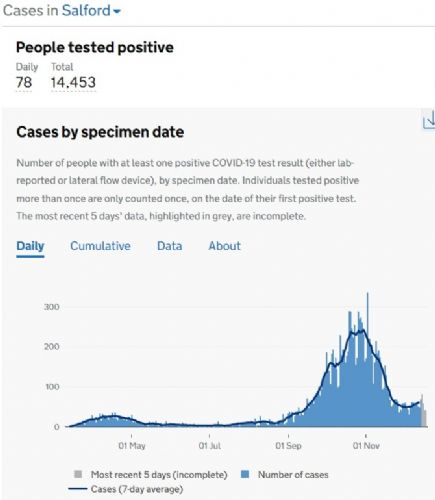
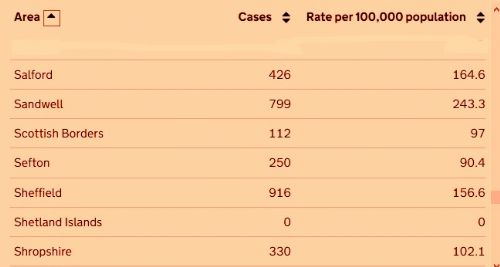
Salford has 78 new coronavirus cases, up from the previous day's 57, bringing the cumulative total to 14,453. The seven day average of cases has increased to 426 up from 405, as has the seven day rate per 100,000 population which stands at 164.6, up from 156.5.
Elsewhere in Greater Manchester, cases in Manchester during the latest seven day data period were 958 (down from 977), with a rate of 173.3 (down from 176.7), followed by Bolton with 440 (down from 453), with a rate of 153 (down from 157.5), and Oldham 487 (up from 450), with a rate of 205.4 (up from 189.8).
Wigan has a seven day case number of 552 (down from 566), with a rate of 168 (down from 172.2), Tameside 239 (up from 213), with a rate of 105.5 (up from 94), Rochdale 480 (up from 478), with a rate of 215.8 (up from 214.9), Stockport 327 (up from 311), with a rate of 111.4 (up from 106), Bury 377 (up from 371), with a rate of 197.4 (up from 194.3), and Trafford 324 (up from 292), with a rate of 136.5 (up from 123).
There have been no new virus-related deaths at Salford Royal Hospital.
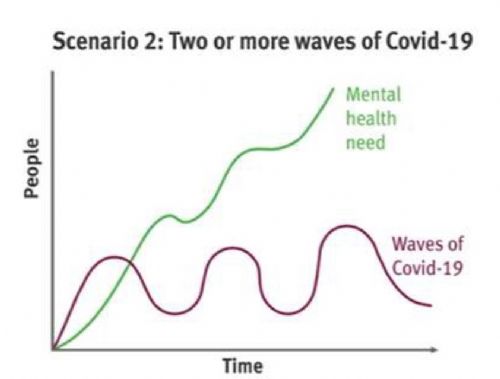
Meanwhile at the latest Health and Social Care Scrutiny Panel of Salford City Council, officers laid out the estimates for people needing access to mental health services...
"It is expected that there will be more people experiencing MH [Mental Health] issues in the general population who do not meet clinical MH thresholds and proactive approaches are needed to ensure issues don't escalate or become enduring" stated the report "This is in addition to the anticipated surge in need/acuity for secondary care mental health services both for existing service users and people not currently accessing NHS mental health services."
Officers were expecting...
...a 25% surge in demand for services run by the voluntary, community and social enterprise sector (VCSE) from December which "will require additional capacity"
...an estimated 15% surge in demand for IAPT (Improving access to psychological therapies), which provides therapies for people with anxiety, depression, panic and Post-Traumatic Stress; plus 50% of people returning to the service who chose not to proceed during the autumn.
...a 15%-40% increase in demand for community mental health services over the autumn, with a 15% average increase expected between January and March
...up to 10% increased demand over the autumn and winter for 'adult acute, PICU, CAMHS, rehabilitation and perinatal' inpatient services.
...a projected gap of 109 mental health beds across Greater Manchester.
...a reduction in workforce capacity up to 3.5% net.
"Due to experiences of COVID-19, the social restrictions imposed by lockdown and the negative impact on the economy there will be a number of emerging and/or exacerbated issues" the report adds "...Some people may not have sufficient protective factors to maintain their mental wellbeing during this time...The demographics within Greater Manchester mean that COVID-19 is anticipated to have a greater impact here than in other areas of the country, exacerbating existing inequalities further."
Issues included accessing therapies which are no longer being carried out on a face-to-face basis; the impact that COVID-19 has had on the lives of all residents of Salford but particularly those with a more severe mental illness; the impact on residents of care homes not currently being able to have visits by family and friends; support to people caring for others during the pandemic; mental health issues which could arise as a result of not being able to find a new job or via the ending of the furlough scheme...
Work was also "being undertaken to ensure that the Salford Suicide Prevention Partnership, including third sector providers, was equipped to provide support to those in need of services..."
With a rise in coronavirus cases already in evidence, before the new strain even takes hold, the mental health fall-out from more Christmas restrictions and possibly more lockdowns is now being recognised as one of the major issues surrounding the pandemic.
"Overall, the devastation of the pandemic has been far reaching and relentless, with lost lives and livelihoods" states Dr Hans Kluge, WHO Regional Director for Europe "COVID-19 has forced families and communities apart, bankrupted businesses, and deprived people of opportunities that a year ago were taken for granted. What has resulted is a growing mental health crisis in Europe.
"From anxieties around virus transmission, the psychological impact of lockdowns and self-isolation, to the effects of unemployment, financial worries and social exclusion - the mental health impact of the pandemic will be long term and far reaching" he adds, quoting national surveys showing that...
* a third or more of the adult population were distressed during the initial stages of the pandemic.
* that half of young people (18-29) are subject to depression and anxiety and that 1 in 6 are 'probably affected'.
* Up to 20% of health care workers are suffering from anxiety and depression.
"It is very clear that although impacted differently, no demographic or age group has been spared" explains Dr Kluge "The mental health toll of COVID-19 will be compounded by anxieties that often present during the winter and holiday season. We cannot underestimate the impact this can have on our friends, our families and the impact on our own mental health.
"Without the traditional physical support networks that are so important, it is vital we take steps to counter the mental health impact on individuals and our communities in any way we can" he adds "In this season of giving, protecting our own mental health and well-being, and promoting that of others, is one of the best gifts we can give.
This has not been an easy year for anyone, if you are feeling low or anxious you are not enduring this experience alone.
"Everyone has different ways of coping, but there are many tools to mitigate feelings of anxiety or depression" he says "From getting out into nature (where permitted), keeping active, to structuring and planning your days - doing things differently can be immensely restorative. At the heart of caring for each other is finding ways to connect; offering and accepting support.
"Mental health challenges remain deeply stigmatized in many communities" he adds "Community sensitization on the spectrum of mental health challenges will be important as the true scale of the crisis becomes clearer. Specialized care and support services need to be sustained for those in the grip of more severe mental health conditions.
"As we prepare for festivities over the next few weeks, whatever modified form they take, let us build on the collective spirit that has helped us navigate the last few months together" he concludes "COVID-19 has shown us we are part of a community, enduring a shared experience. Despite the physical distance we have an opportunity to connect and care. The many social networking tools we have at our finger tips make it easier to reach out. The holiday season is the perfect excuse to reconnect.
"Let us mobilize our social and community networks as well as the support services that are a lifeline to the marginalized, isolated and those in need of continuing care and treatment" he adds "Mental health services have been stretched and reduced because of pandemic response, it is imperative that health systems have the resources to catch up in 2021."
For a list of services in Salford helping people with mental health issues – click here
If anyone wishes to promote any organisations providing additional help please use the comments box




.jpg)


.jpg)
.jpg)
(3).jpeg)
.png)
(1).JPG)
