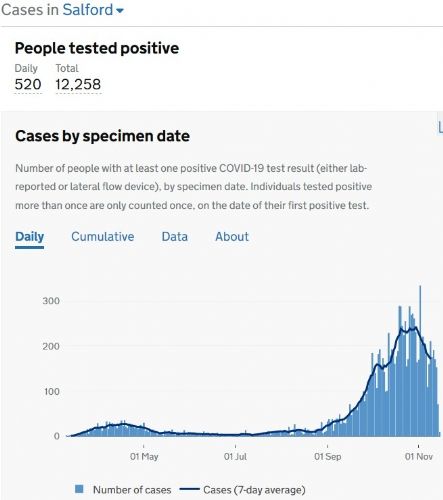
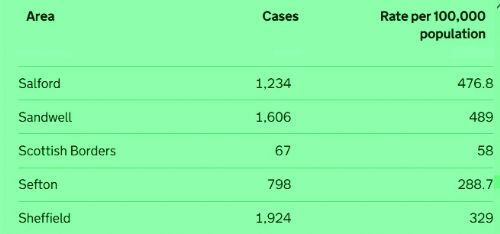
Salford has 520 new coronaviris cases, a huge rise of 375 cases on the previous day, bringing the cumulative total to 12,258. The seven day average of cases has increased from 1,221 to 1,234, as has the seven day rate per 100,000 population which rose from 471.7 to 476.8. The rise in cases could be down to correcting previous figures, as nowhere else in Greater Manchester saw a dramatic rise in cases.
Elsewhere in Greater Manchester, boroughs saw a slight drop or rise in seven day totals. Cases in Manchester during the latest seven day data period were 2,173 (down from 2,213), with a rate of 393 (down from 400.3), followed by Bolton with 1,323 (up from 1,314), with a rate of 460.1 (up from 457), and Oldham 1,505 (down from 1,551), with a rate of 634.7 (down from 654.1).
Wigan has 1,629 (down from 1,648), with a rate of 495.6 (down from 501.4), Tameside 969 (up from 904), with a rate of 427.8 (up from 383.4), Rochdale 1,223 (up from 1,202), with a rate of 549.9 (up from 540.4), Stockport 990 (up from 960), with a rate of 337.4 (up from 327.2), Bury 1,003 (down from 1,010), with a rate of 525.2 (down from 528.8) and Trafford 861 (down from 910), with a rate of 362.7 (down from 383.4).
There have been no new virus-related deaths announced by Salford Royal Hospital.
Tales of the Excluded
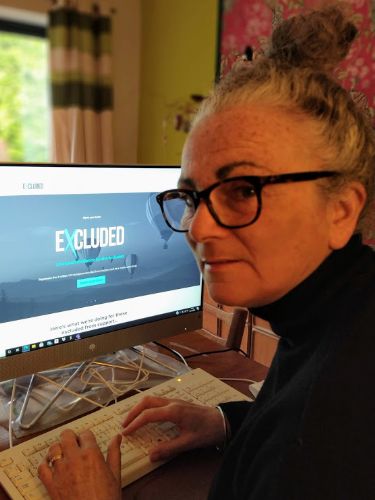
This week, the Salford Star is running personalised stories of those Greater Manchester people excluded from financial support during the coronavirus crisis. Today we feature Sarah-Louise Wainright, a former lead nurse at The Height General Practice on Bolton Road, who later became a self-employed trainer and educator within primary healthcare after 32 years of full time employment.
"As COVID-19 took hold in March, training and education for healthcare workers became a non-priority for employers; it became impossible to factor face to face contact with my customers...and with lockdown contact restrictions in place my work simply stopped and my self-employed income with it" Louise explains.
Her earnings have basically collapsed, down 68% on last year but she is Excluded from the Self Employed Income Support Scheme (SEISS) due to taking early retirement and her pension income is greater than self employment income profits – the 50% Rule.
Louise is also Excluded from Government grants administered by local authorities due to working from her home and customer premises (no business premises with rateable value); Excluded from JSA due to not paying class 1 (Employee) NIC; and Excluded from Universal Credit due to modest savings amassed over forty and more years, exceeding the threshold...
"I am in a much better financial situation than many of the people excluded, I have my pension, my husband has his pension and together they cover our bills" she says "We also have some savings which we have called upon to top up our monthly income, but it cannot be right that when you have paid all your taxes for over four decades that on the one occasion when, through no fault of your own, you need to rely on the Government for financial support then due to arbitrary discriminatory policies it is denied to you.
"Time and again there have been opportunities to address these gaps in support but Rishi Sunak has steadfastly refused to do so and it makes you wonder what his agenda and motivation is in doing this is" she adds "I educate and train healthcare professionals and equip them to carry out their roles safely and with all the up to date knowledge needed, a role that is both viable and vital, before, now and going forward.
"In my particular situation, having financial support would allow me to take the time to listen to the needs of my customers, find out how best to provide the services that they need and to both develop new and adapt my current products and services to meet their requirements for future training on remote digital platforms" she argues.
For more details see the ExcludedUK website – click here and Facebook group – click here




.jpg)


.jpg)
.jpg)
(3).jpeg)
.png)
(1).JPG)
