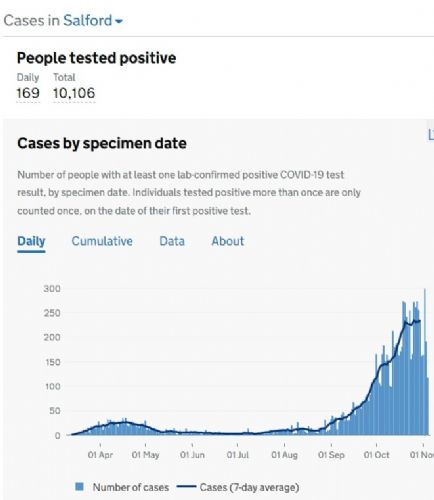
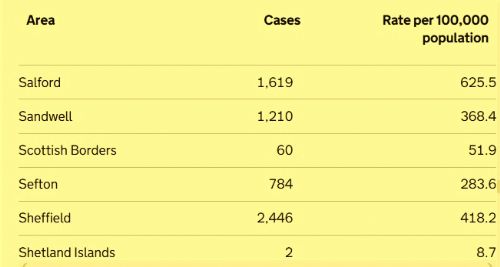
Salford has 169 new confirmed cases of coronavirus, bringing the cumulative total to 10,106, up from the previous day's 9,937. The number of cases over the last seven days of data decreased slightly from 1,620 to 1,619, with a rate per 100,000 population of 625.5, down from 625.9.
Elsewhere in Greater Manchester borough areas numbers and rates continue to vary between increasing and declining slightly. Cases in Manchester during the latest seven day data period were 2,603 (down from 2,624), with a rate of 470.8 (down from 474.6), followed by Bolton with 1,604 (down from 1,623), with a rate of 557.8 (down from 564.4) and Oldham 1,755 (down from 1,756), with a rate of 740.2 (down from 740.6).
Wigan has 2,181 (down from 2,221), with a rate of 663.6 (down from 675.8), Tameside 1,219 (down from 1,220), with a rate of 538.2 (down from 538.6), Rochdale 1,306 (down from 1,325), with a rate of 587.2 (down from 595.7), Stockport 1,311 (up from 1,307), with a rate of 446.8 (up from 445.4), Bury 1,100 (up from 1,077), with a rate of 575.9 (up from 563.9) and Trafford 946 (up from 925), with a rate of 398.6 (up from 389.7).
There have been five new virus-related deaths announced by Salford Royal Hospital.
Meanwhile, Salford's mass 'Operation Moonshot' rapid testing trial, which was recently scaled down from the whole of the city's population to key health workers, has come under fire from Greater Manchester's Mass Testing Group (MTEG) for only picking up under half of positive cases.
In a letter seen by the Guardian, the scientists wrote "The current available data from the Manchester [sic] pilot shows low sensitivity (46.7%) of the Direct RT-Lamp platform", adding that they had "significant concerns" about its large scale roll-out.
The Department of Health and Social Care hit back via Professor Mark Wilcox, who argued that "It is incorrect to claim the tests have a low sensitivity, with a recent pilot showing overall technical sensitivity of nearly 80% rising to over 96% in individuals with a higher viral load, making it important for detecting individuals in the infectious stage.
"The challenge now is to understand the reasons for the difference in claimed sensitivity in one evaluation versus those in multiple others" he added.
Back on 14th October, the Salford Star reported doubts cast on the project by Salford and Eccles MP Rebecca Long Bailey, who told the House of Commons that "My local council confirmed to me this morning that some time ago now they'd asked the Department for Health to share the clinical validity data behind this new technology. To date this query remains unanswered..."*
Salford City Council had paused the programme until this date but then apparently re-started it just for health workers.
The Star also reported a pending court case being brought by a group of doctors and lawyers - Good Law Project, Dale Vince, AI Diagnostics and EveryDoctor - questioning both the validity of the rapid tests and the transparency surrounding the awarding of contracts for the trial.
The group reported recently that "'Operation Moonshot', Government's grand plan to develop a rapid turnaround testing programme, has predictably fizzled out into a damp squib...
"'Operation Moonshot' will be absorbed into the existing Test and Trace programme" the group added "They have also abandoned plans to spend £100 billion, a figure first revealed in the Government's own leaked documents, on the project."
As usual, Salford Council is saying nothing, with Salford City Mayor, Paul Dennett, tweeting yesterday about the flower beds on the Civic Centre's lawns...
...However Rebecca Long Bailey did tweet about "worrying reports that rapid Covid test missed over 50% of cases in trial. Issues about efficacy were raised with Gov weeks ago and must be urgently addressed..."
* For a full background on 'Operation Moonshot see previous Salford Star articles - click here and click here




.jpg)


.jpg)
.jpg)
(3).jpeg)
.png)
(1).JPG)
