After what Greater Manchester Leaders called the "chaos" of the last few days, when Trafford and Bolton were one minute lifted out of increased restrictions and the next minute shoved back in, at this afternoon's press conference they demanded that local councils should be in the "driving seat" of coronavirus control.
They agreed that the current restrictions are not having an impact and that the control of the virus has to be managed in a new way.
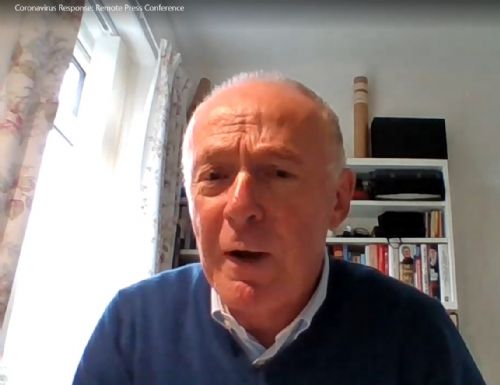
While cases are rising, GM Health Lead, Richard Leese, produced figures that showed this was not due to increased testing – in Trafford, statistics from a few weeks ago showed increased testing but falling cases, while across Greater Manchester over the last week, there was a reduction in testing but increased cases.
Nevertheless, the increased cases are not leading to more hospital admissions, more 111 calls or people contacting GPs
"What we're dealing with now is very, very different from what we were dealing with in April" Leese explained "It might be the same infection but it's having a very different impact, a smaller impact at the moment..."
He backed this up with Greater Manchester figures contrasting the week ending 27th April with the last week...
In April, there were 38 hospital admissions per day, in the past week, two. In April there were 136 patients in intensive care, in the past week 15. In April there were 827 people in non-intensive care, in the past week 69. And in April there were 237 deaths in hospitals, in the past week, eight.
"It suggests that we need to be managing it differently" Leese concluded, adding that other health issues, like mental health problems, delayed cancer treatment, summer flu and economic issues were having a bigger impact on people's lives than COVID-19 and that "we need a more proportionate approach".
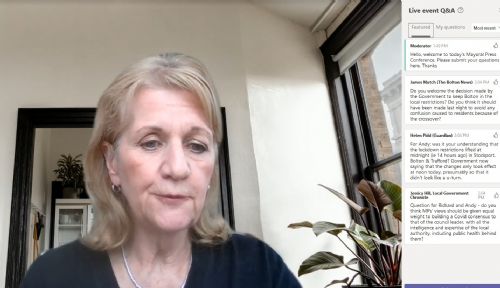
Meanwhile, Beverley Hughes, Greater Manchester's Deputy Mayor for Policing, Crime, Criminal Justice and Fire, talked about a "lack of credibility" with enforcing the restrictions which are "resented" by the public as they are inconsistent, particularly around households not mixing in houses and gardens when they can mix in a pub garden, and the variations in boroughs across Greater Manchester.
She added that there was "confusion and a lack of clarity" from the Government which was bringing enforcement into "disrepute". Over the bank holiday four days, there were six hundred COVID-19 incidents, with nearly four hundred of those relating to house parties and 140 license breaches. Eleven arrests were made and just 25 Fixed Penalty Notices issued.
Between March and May, 305 Fixed Penalty Notices were issued but only 143 people had paid the fines... "It's got to make sense to the public, it's got to be feasible for the police to implement" Hughes concluded.
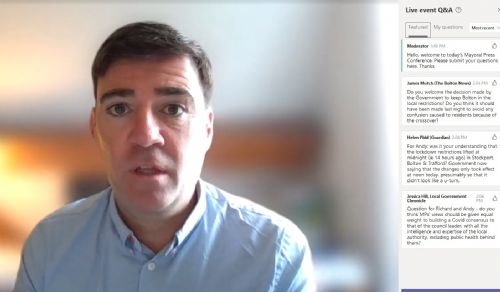
So, with Richard Leese saying that things are very different from the early lockdown scenario, and Beverely Hughes saying that enforcement isn't credible, it was left to Andy Burnham to set out the call for a new 'exit strategy' for Greater Manchester...
"Crude blanket restrictions can only now be seen as an interim measure" he said "We need to plan for an exit strategy from this to a much more sophisticated, targeted approach with high impact interventions in our communities...We need to plan for the phase beyond these restrictions where they can be removed in all boroughs and we can enter a new phase that is a much better way of managing the risks that we face..."
Burnham demanded local control of the test and trace system, with door-to-door interventions; financial support for those self-isolating; for restrictions to be lifted as soon as possible, and for local councils to be in control of any restrictions...
"We are closer to our communities when decisions are to be made" he said "We need to do all the preventative measures but having restrictions as a last resort...National Government sitting in Whitehall imposing decisions on local communities has got to stop.
"It isn't working, it's confusing people and causing anger and resentment" he added "We need to move now towards a more sophisticated approach as soon as we possibly can: to seek to move beyond restrictions and give the public new hope..."
He said that the effect of the restrictions has diminished over time and they are not bringing the case numbers down..."The restrictions were right at the time but as we go further into this we're saying very clearly that we need now to plan for an exit from those restrictions, with a new much more sophisticated high impact strategy in our communities, combined with financial support and lead roles for councils. The longer the restrictions have been in, the more confusion has grown around them, and the less effective they are becoming."
So, basically, Salford City Council would have the power to impose or lift restrictions if it thought it was necessary, to bring control more locally but Salford Council has hardly said a word about any local outbreaks or testing figures or anything.
The Salford Star asked whether local councils should be providing more information to their residents, rather than leaving it to Andy Burnham to say everything - and take the stick on social media?
"I'm well used to stick on social media so that doesn't matter, it comes with the job" Andy Burnham replied "Mayor Paul Dennett has said quite a lot about testing and local outbreaks [really?] but what we've tried to do is bring it together in one place in this weekly press briefing. We are trying to work as one, and I hope that the Greater Manchester approach has been helpful."
He concluded that "there will be changes in the figures as we go through the winter and autumn but let's not over react to that and get better at managing that, and have the decision making vested in the local authority."
On upcoming challenges of schools, colleges and universities returning, plus the flu season and more, Richard Leese, admitted that there was no definitive safety measures...
"New Zealand thought it could be COVID secure because it's an island in the middle of nowhere; it didn't work" he said "If they can't do it there, we certainly can't do it in our schools. This is about assessing risk and managing risk. And the starting point is being real about what has been happening over the past few months...
"If we feel that our young people have all been sat at home in wonderful isolation all the time you're not in the real world" he added "...all that mixing has been taking place anyway, and is reflected in figures. In terms of schools, the evidence we have so far is that unless they have other health issues young people are at low levels of risk and are less likely to transmit. The risk comes down to adults and older people and that's how we start to manage it – protect older people who need protection...We won't eliminate it...but we ought to be able to keep it under control and ensure that people who are the most vulnerable are kept safe."
And Beverley Hughes concluded that "The impact on people who are getting infected is much less serious and figures on hospitalisation and deaths is encouraging. I think we are all aware though that we need to treat that with caution.
"I think that the most vulnerable people to this illness still aren't mixing socially very much at all and so we don't know if the infection rises what impact that would have on them were they to become infected" she said "It may be the same as before or it may be that the virus has mutated somewhat but we actually just don't know, so we need caution for that reason..."
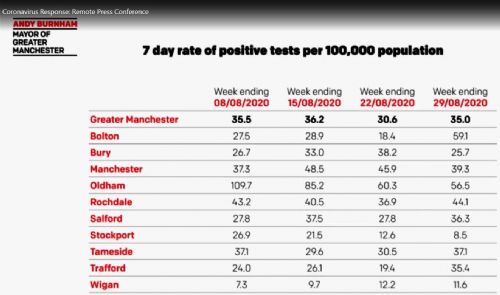
Meanwhile, the seven day rate of positive tests per 100,000 people in Salford for the week ending 29th August has risen to 36.3, up from 27.8 the previous week.




.jpg)


.jpg)
.jpg)
(3).jpeg)
.png)
(1).JPG)
