Salford has six new confirmed cases of coronavirus, bringing the cumulative total to 1,732, up from the previous day's 1,726.
Elsewhere In Greater Manchester, cases in Manchester rose to 4,098 (up from 4,054), followed by Oldham with 2,793 (up from 2,770), Wigan 2,294 (up from 2,289), Bolton 2,231 (up from 2,218), Rochdale 2,171 (up from 2,160), Stockport 1,958 (up from 1,955), Tameside 1,865 (up from 1,855), Trafford 1,620 (up from 1,609) and Bury 1,544 (up from 1,536).
There has been one sad new virus-related death at Salford Royal Hospital.
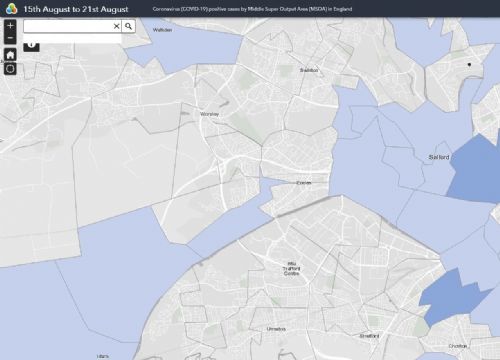
A new map of virus cases in Salford Middle Super Output Areas for the week 15th to 21st August shows over fifty cases with the most within the Salford Central and University areas, which includes Lower Broughton.
Higher Broughton had no cases for the first time since the map was published. The full list is...
Salford Central and University – 11
Pendleton – 6
Lower Irlam and Cadishead – 5
Ordsall and Salford Quays – 4
Patricroft – 4
Weaste and Seedley – 3
Cromwell Road and Broad Street – 4
Langworthy Buile Hill – 3
Lightoaks – 3
Swinton South East and Pendlebury West – 3
Higher Irlam – 3
Walkden South – 3
Meanwhile, new data released today from mental health anti-stigma campaign, Time to Change, reveals that 47% of 11-18 year olds in the North West are worried that returning to education will impact their mental health, but that only 23% of parents have spoken to their children about their mental health since the start of the summer break.
However, the data also shows that 72% of parents in the North West said they would know how to spot the signs if their child was struggling...
"One in eight young people will experience a mental health problem in any given year" says Jo Loughran, director of Time to Change, which is run by the charities Mind and Rethink Mental Illness "However, at this moment in time, many more are concerned about their mental health – regardless of whether they have a diagnosis.
"It's great that parents feel able to spot the signs, but we want to reassure them that having a conversation with their child won't make them more susceptible to mental health problems or create issues that aren't already there" she explains "It simply means they will know you are open to the topic, willing to listen and ready to support them if and when they need it."
Time to Change has produced support materials for parents, students and schools – to find out more click here and click here
As young people face new anxieties about returning to education, the Dogs Trust charity is also worried about canine angst and is warning of an 'impending dog behaviour crisis'...
Today the Trust reveals its new research showing that a third of owners in the North West say their dog has developed at least one new problem behaviour during lockdown and is issuing advice on how to help their pets adjust when they return to work.
During the actual lockdown itself, interviews with over six thousand owners including those in the North West, showed a 74% increase in reports of dogs whining or barking when a household member was busy; a 50% increase in reports of dogs frequently seeking attention from their owner; a 101% rise in the number of people saying their dog has hidden or moved away when approached; and a 56% increase in reports of dogs being clingy or following people around the house.
Now, the Dogs Trust is stating that "The risk of dogs developing separation anxiety is an urgent concern...This is particularly the case for puppies, who may never have had experience of being left home alone during the lockdown..."
Rachel Casey, Director of Canine Behaviour and Research at Dogs Trust adds: "These are challenging times as millions of us across the country have had our daily lives turned upside down. Whilst some dogs have been happy to have their human family at home more, others have been stressed by reduced exercise, inability to find a quiet place to rest or no contact with other dogs.
"A big worry for us is what the long-term impact of lockdown will have on dogs' ability to cope when left home alone" she explains "Dogs that had separation anxiety before the lockdown are likely to get worse when left again as owners head back to work – but we also expect to see new cases developing, because other dogs, and particularly puppies, have learnt to expect company all day. We could well see a rise in the number of dogs needing our help or being abandoned because of this."
For more information on how to prevent separation anxiety or to donate to its coronavirus appeal see the Dogs Trust website – click here
Or if you're struggling to cope with looking after your dog contact the charity on 0300 303 2188




.jpg)


.jpg)
.jpg)
(3).jpeg)
.png)
(1).JPG)
