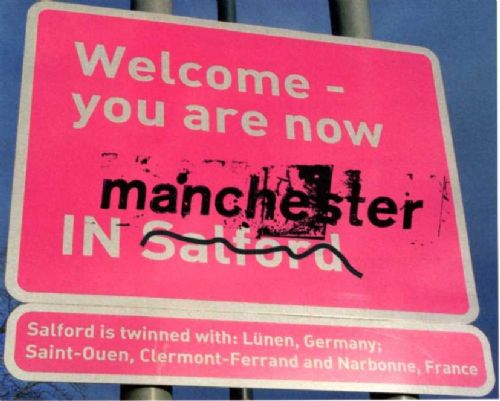
Yep, the Salford Star has been shouting it from the first printed issue that the big plan was to integrate Salford into an expanding Manchester city centre.
Now it's official that by 2030 Salford will be part of what's being called the `Regional Centre' - which in all but name will mean Salford becomes part of Manchester, and will bow to a `Regional Strategy' for investment, housing, transport and other services.
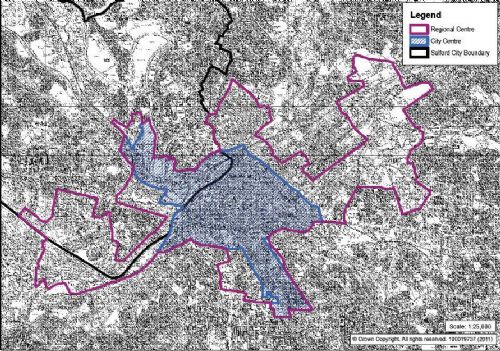
The Regional Centre boundary will stretch from Manc-land right up to MediaCityUK on one side and to the Innovation Forum on Frederick Road on the other, incorporating Salford University. This would explain the University's new branding which screams `University of Salford, Manchester' (see here).
What is even more interesting is that the boundary line for the new `Regional Centre' manages to weave its way around some of the most deprived parts of Salford. For instance, Greengate (on the Manc border) is included in the `Regional Centre' but Greengate North and Trinity aren't included. Ordsall Waterfront is included but Ordsall itself isn't.
Ordsall Waterfront (where the Council has destroyed the culturally infamous Graffiti Palace [see here]) is the `Irwell River Park' walkway between Manc and MediaCityUK, where it's proposed to plonk billions of yuppie flats and houses along the Ship Canal, across the road from Ordsall itself.
The `Regional Centre' is defined as The Crescent, Greengate, Liverpool Street, Ordsall Waterfront, Salford Central and Salford Quays, although from the blurred maps Salford Council has produced it's almost impossible to tell exactly which bits of Liverpool Street and Salford Central are included.
Parts of Central Salford that are left out of the `Regional Centre' boundary include Pendleton, the whole of Broughton, Charlestown (except for the Innovation Forum) and Lower Kersal, Claremont and Weaste, and Eccles New Road.
Salford Council is proposing that over 43% of all new housing in the city will be in the `Regional Centre', with the number of second homes more than doubling. The last Salford Housing Needs Assessment in 2007 estimated that there were 2,273 households living in overcrowded conditions in the city.
These proposals for the `Regional Centre' are revealed in Salford Council's Development Plan Core Strategy Pre Publication Consultation (click here) which defines the `Regional Centre' as Manchester/Salford City Centre but with more and more services being amalgamated across the city many people might draw the conclusion that the two cities are merging, with Central Salford being part of Manchester in all but name.
The Development Plan document states… "By 2030, it is envisaged that this scale of investment will have transformed the role of the corridor along Chapel Street and the Crescent, helping to ensure that it forms an important and integral part of the Manchester/Salford City Centre".
Meanwhile, back in April, Salford Council's Chief Executive, Barbara Spicer, compared her relationship to Manc's Chief Executive Howard Bernstein, as like that between mother and daughter, which is hardly equal.
"It's a little like you'd say 'Mum, what do you think about this?'" Spicer cooed to the Manchester Evening News, adding "In terms of developing the core of the conurbation, we take a very singular view and that is one of the things that we will look at in the round: we discuss which sites we are going to bring forward."
It seems that those sites which are being brought forward to be part of the `Regional Centre' are only those bits that will be of advantage for the expansion of Manchester City Centre.
To read the full Development Plan Consultation click here
• The Consultation ends on Monday 1st August and details of how to comment on the proposals are contained within that document.
• Campaigners against Peel Holdings proposals for over 500 houses on the greenfield site of Burgess Farm which are also contained in the document are urging Salford residents to object – click here for full details.




.jpg)


.jpg)
.jpg)
(3).jpeg)
.png)
(1).JPG)
