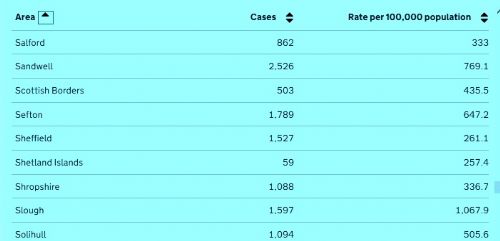
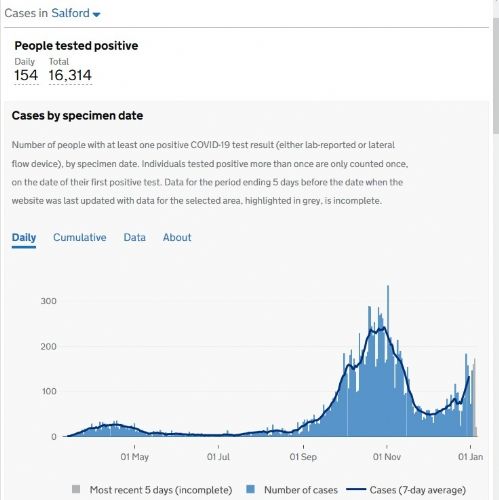
Salford has 154 new coronavirus cases, up from the previous day's 131, bringing the cumulative total to 16,314. The seven day average of cases has increased to 862, up from 772, while the seven day rate per 100,000 population now stands at 333, up from 298.3.
Elsewhere in Greater Manchester, the seven day average of cases in Bury is 743 (up from 676), with a seven day rate per 100,000 population of 389 (up from 353.9); Bolton 808 (up from 749), with a rate of 281 (up from 260.5); Manchester 1,974 (up from 1,798), with a rate of 357.1 (up from 325.2); and Oldham 743 (up from 692), with a rate of 313.4 (up from 291.8).
Rochdale has a seven day average of cases of 753 (up from 696), with a seven day rate of 338.6 (up from 312.9); Stockport 1,121 (up from 1,029), with a rate of 382 (up from 350.7); Tameside 708 (up from 650), with a rate of 312.6 (up from 287); Trafford 957 (up from 865), with a rate of 403.2 (up from 364.4); and Wigan 1,331 (up from 1,168), with a rate of 405 (up from 355.4).
All boroughs of Greater Manchester, except Bolton, now have seven day rates above 300, with two boroughs, Trafford and Wigan, above 400.
There have been two new virus-related deaths at Salford Royal Hospital, which according to the latest data for 4th and 5th January, has the highest number of COVID-19 patients in the hospital – 164 and 159 - since the November peak of 168, and above the April peak of 136.
As of 5th January, there were 16 COVID patients in intensive care, or ICU, beds, compared to a November peak of 23, and an April peak of 20.
Meanwhile, a survey of over one thousand Greater Manchester residents, carried out in November and December on behalf of Greater Manchester partners provides a detailed insight into the impacts of the pandemic.
There are no great surprises in the survey, with four fifths of residents worried about coronavirus at least 'somewhat' (80%). This includes two fifths of GM residents who are 'extremely' or 'very worried' (40%).
The proportion of 'extremely/very worried' increases to half among residents with a disability, where someone in the household has been told they are high risk, and among residents with children aged 0-4 years, those in the 'most deprived' communities, and those who have served in the armed forces.
Other conclusions include...
More than half express concern with getting GP and dentist appointments, and about their health generally.
More than half are concerned about their mental health, with one in four considering this a 'big concern'. Females and young people are among those most likely to consider their mental health and feeling anxious for the future a 'big concern'.
One in five GM residents have 'big concerns' about the cost of heating their home, being able to afford food and other essentials, and their rent or mortgage.
Young people, carers and those who live in the most deprived communities are typically more concerned about their finances.
One in five have 'big concerns' about caring for elderly relatives/friends, or those needing assistance; or being able to visit loved ones in care homes/other settings; those most concerned about these issues include BME residents, residents with a disability or someone at high risk of COVID in their household, and those with children aged 0-4yrs.
One in seven have 'big concerns' about their relationship with their spouse/partner; residents with children aged 0-4yrs, carers and Muslim residents are among those most likely to say this has become a 'big concern'.
The proportion for whom accessing services has become a 'big concern' is higher than average among 25-44yr olds, those with young children, BME and Muslim residents, among others.
Unfortunately, when asked about the national lockdown in November (at the time of the survey), Salford residents, more than any others in Greater Manchester, incorrectly believed they could do actions that were banned under the restrictions.
One in four residents in Salford (and Bolton) on average stated that they were most in need of practical support with shopping, medicine delivery, essential travel, help with exercising and eating healthily. 38% of Salford respondents also needed mental health support or advice.
27% of Salford residents who responded had had their hours reduced at work, while 20% had their pay reduced.
There are loads more details in the 86 page survey – to read it click here




.jpg)


.jpg)
.jpg)
(3).jpeg)
.png)
(1).JPG)
