"These are shocking figures. It is nothing short of a disgrace..." National Education Union
Statistics published today by the End Child Poverty coalition have revealed growing rates of child poverty in the UK, with increases of ten percentage points in some areas underlining what the coalition calls "the growing crisis of child poverty".
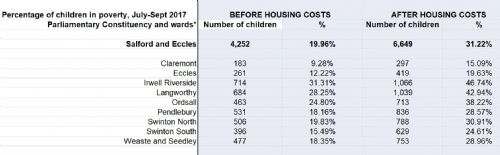
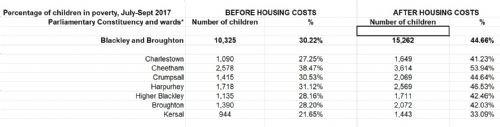
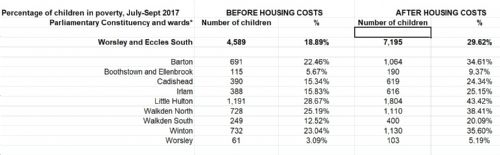
A child is said to live in poverty if they are in a family living on less than 60% of median household income, around £248 per week after housing costs. In Salford this equates to 17,423 children living in poverty, with five areas of the city having rates above 40%...
Top is Irwell Riverside with 46.74%, followed by Little Hulton (43.42%), Langworthy (42.94%), Broughton (42.03%) and Charlestown (41.23%).
Four out of these five areas of extreme child poverty have been subject to massive regeneration schemes over the last decade which were supposed to improve the community's life chances. These latest figures show that they have failed miserably.
Overall, Blackley and Broughton has a child poverty rate, after housing costs, of 40.03% at December 2015, Salford and Eccles 31.9%, Worsley and Eccles South 29.4%.
Salford has the fifth highest number of children living in poverty in Greater Manchester, with Manchester itself the worst area with 51,034, followed by Oldham (24,425), Bolton (23,405) and Rochdale (18,921). The figures show that over 200,000 children live in poverty in Greater Manchester.
The constituency of Oldham West and Royton has the second fastest growing child poverty in the country, up ten percentage points since 2015, while Manchester Gorton comes fifth in the country, rising by six percentage points. This contrasts with the Maidenhead constituency of Theresa May which is among the 25 with the lowest child poverty.
Now, the End Child Poverty coalition, which comprises almost one hundred organisations including children's charities, trade unions, social justice groups and faith groups, is calling on the Chancellor to end the freeze on children's benefits - currently in place until the end of the decade - so that families no longer see living standards squeezed as prices rise.
"It is scandalous that a child born in some parts of the UK now has a greater chance of growing up in poverty, than being in a family above the breadline" says Sam Royston, Chair of End Child Poverty and Director of Policy and Research at the Children's Society "There can be little doubt that the Government's policy of maintaining the benefits freeze despite rising prices is a major contributor to the emerging child poverty crisis."
The coalition is also concerned that the impact of poverty may be exacerbated by a poverty premium - which means that low income families can face paying as much as £1,700 per year more than better off families, to buy the same essential goods and services. A major contributor to this is the high cost of credit for low income families, and the coalition wants to see the Government address this by providing better access to interest free credit.
"No family in modern Britain should be struggling to put food on the table, heat their homes and clothe their children" Sam Royston adds "End Child Poverty is calling on the Chancellor to end the freeze on children's benefits, and to invest in interest free credit for low income families, to ensure that poverty doesn't result in spiralling debt."
Commenting on the new 'child poverty map' figures, Dr Mary Bousted, joint general secretary of the National Education Union, says: "These are shocking figures. It is nothing short of a disgrace that, in one of the wealthiest countries on earth, there are constituencies where more than half of children are growing up in poverty.
"Sadly, however, these figures will not come as a surprise to many of our members who see the disastrous effects of poverty on children and families every day" she explains "This includes a rising number of children coming to school tired and hungry because their parents cannot afford to provide meals at home. Teachers and education professionals are also aware of the impact that poverty has on children's ability to learn, something that is reflected in figures which show a persistent link between poverty and attainment. If you are hungry and concerned about the lack of money at home, this will have an effect on your experiences of school and education.
"With news that some of the most deprived areas of the UK have seen the biggest increases in child poverty since these figures were last released, the Government can no longer deny that there is a growing crisis of child poverty in the UK and must take measures to address this" she adds "We support calls for the Chancellor to immediately end the benefits freeze. For the Government to claim that it wants to boost opportunity and 'social mobility' while at the same time pursuing policies such as this which are increasing child poverty is nothing short of hypocrisy."
For more details, to read the full report and to see an interactive map of child poverty in the UK see the End Child Poverty website – click here




.jpg)


.jpg)
.jpg)
(3).jpeg)
.png)
(1).JPG)
