"These photographs are not just a slice of life; they are testimony to a way of living and are in that sense extremely political..."
It took decades for Kersal photographer Shirley Baker, who died in 2014, to get the recognition she deserved outside of the North West. But now her depictions of inner city Salford and Manchester during what is known as the 'urban clearances' are seen as iconic and pioneering.
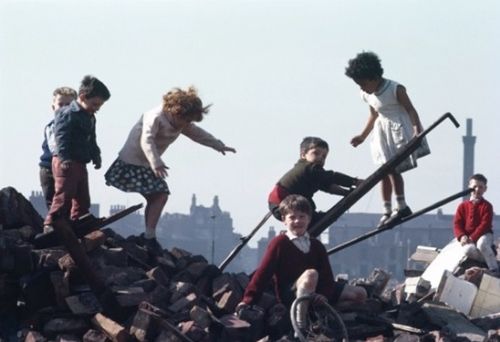
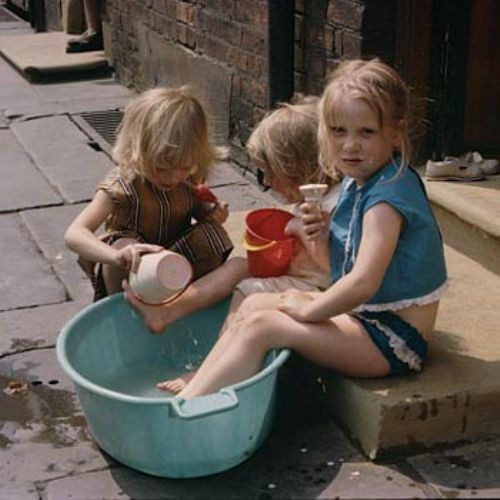
The photos show kids playing in streets and on the rubble of 'bombsites'; mums chatting to neighbours, and men...well, just 'loitering', as the title of a new major exhibition of Shirley Baker's work suggests.
Shirley Baker: Women and Children; and Loitering Men, opens at Manchester Art Gallery this Friday 19th May and runs until 28th August, showing 160 pictures from early 1960 to 1980, complete with magazine spreads, contact sheets and a soundscore composed by Derek Nisbet, of street noises and Shirley Baker's voice.
There's also an audio guide that includes people who were actually in the photos, or who lived in the streets, talking about what life was like...
"...Well, it wouldn't just be a game...you would be in an adventure" states one participant "...this could end up with them building some sort of a den...But they're completely forgetting about the risk, because there's nobody there to say 'That's a dangerous place for you to be, come down at once'. Nobody does that, because you are free. You're absolutely free..."
Shirley Baker, whose reputation is soaring, documented this way of life and its ending; and both she, and now Anna Douglas, the curator of this exhibition, are adamant that the photos are not taken as some twee nostalgia trip...
"Nobody who lived there felt that they were living in a slum" says Anna "They felt they were living in working class communities that were very old and very solid, and actually had very high social values.
"One of the things that Shirley was concerned about was that when you were demolishing houses you weren't just demolishing bricks and mortar, you were actually demolishing communities that were long serving, that had taken generations to build up" she explains.
"People had extended families living very close to them and that sense of community was very special, and very unlike middle class communities" she adds "Working class communities, she felt, had very different value systems and quite humanist values not based on consumerism... she empathises with a very different set of social values – of community and social networks and non-materialism...the children become a kind of symbol of a different way of life, full of adventure, curiosity, creativity; values that are not dependent on wealth, in contrast to the middle class.
"She spends 21 years in these streets because she is dismayed by the way that these communities are being broken up and the way people are being treated" says Anna "These photographs are not just a slice of life, they are testimony to a way of living and are in that sense extremely political.
"They are not nostalgic" she insists "They are recording the past but these people were cleared out of their homes as if they had no voice. And Shirley felt, as a photographer, the one thing she could do was give them a voice; a presence to say they existed.
"No consideration was given to what is a community" she adds "There was some element of gratitude for moving into modern houses but a huge amount of despair and disillusionment about having their sense of connection to other people broken up. In the late Fifties, people were moved street by street but by the Sixties and Seventies there were too many people to do that.
"She was morally outraged by the way people were being treated by what could be loosely called the authorities" Anna says "She felt that there was a great injustice in the way that people were being forcibly moved in what was known as 'the 'clearances'..."
It's a history that continues to repeat itself, and has repeated itself in Higher and Lower Broughton, Langworthy and Seedley, Lower Kersal and Charlestown, Ordsall and lately, Pendleton...
In the year 2000, The Lowry commissioned Shirley Baker to re-visit Salford and Manchester for a book called Streets and Spaces, contrasting photos she'd taken in the Fifties, Sixties and Seventies with new depictions of life at the turn of the millennium. In the 16 years since this was published, many of streets and places featured have again been demolished.
One thing Shirley Baker did note in 2000 was that "Sadly, the gulf between rich and poor may be even wider now than before..." By 2017, that has become a chasm. And communities continue to be broken up – if not by mass demolition, then certainly by the rising unaffordability of housing in what is still known as 'proper Salford'.
Shirley Baker: Women and Children; and Loitering Men
From Friday 19th May – 28th August
Manchester Art Gallery
Mosley Street, Manchester, M2 3JL
0161 235 8888 Open daily, 10am- 5pm, and Thursdays 10am-9pm
Free entry
For further details on the exhibition - click here
Throughout the exhibition, which is a collaboration with The Photographers' Gallery in London, there will be events and special tours, and the Salford Star will be doing further previews.




.jpg)


.jpg)
.jpg)
(3).jpeg)
.png)
(1).JPG)
