'A new branch of the Union had been formed at Gerard's, Swinton, and an interview was pending with the firm to point out the illegality of deducting the 2/6 advance granted to Munition Workers, as a fine for any time lost...'
'A branch had been organised at Bolton and it was discovered that very low wages were being paid. An application had been sent in for the rates paid in other wood shops to apply to the women working at this firm..'
'It was reported that the Upholsteresses and Women Polishers were on strike. They were asking for an increase of 2d an hour on their present rate of 7d...'
Back in the day - so far back it could be today - women were generally in low paid jobs with poor conditions. In February 1895, the Manchester and Salford Women's Trades Union Council (MSWTUC) was formed specifically to organise women into trade unions.
With no fast food outlets and call centres around then, the Council fostered trade unions among sewing machinists, upholsteresses, tailoresseses, cigar makers, cotton power loom weavers and other trades.
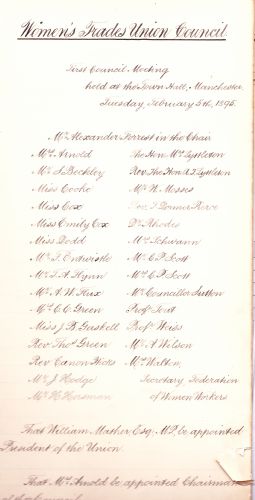
Its early supporters included C P Scott, editor of the Manchester Guardian, who personally wrote the minutes of the first two meetings, Julia Gaskell, daughter of social campaigner Elizabeth Gaskell, and one 'Miss Pankhurst'. Also prominent were grassroots activists like Olive Aldridge, Emily Cox, Sarah Dickenson, Eve Gore Booth and Mary Quaile...
...So it's fitting that on Saturday 29th April, at the Mary Quaile Room in the Mechanics Institute, the contemporary Mary Quaile Club will launch a unique website featuring transcriptions of two handwritten volumes of minutes of the Manchester and Salford Women's Trades Union Council between 1895 and 1919.
The minutes came to light during research into the life of Mary Quaile, who worked for the MSWTUC as an organiser. Her great-nephew, Martin Ennis, presented them to the Mary Quaile Club, and it seems that Mary took them with her when the MSWTUC office closed in April 1919 after the Council merged with the Manchester Trades Union Council.
"We believe that these minutes are a unique item of national significance and will be a major contribution to our knowledge of women workers and trade unionism in the late 19th and early 20th Century" says Mary Quaile Club member Bernadette Hyland, who transcribed the volumes.
"The minutes are hand-written, cover 760 pages in total, and are the complete record of the meetings of the Council, including both the decisions reached and also often what was said by those attending" she adds "They show the daily grind of supporting and encouraging working women into trade unions and agitating for decent pay and proper working conditions.
"A century later, women still face many of the same problems with cuts in pay, benefits slashed and the growth of zero hour contracts" she explains "We feel that the work of the Council can be an inspiration to today's women workers."
The website will contain both the transcription and copies of the original minutes, and the project has been funded by donations from individuals and from trade unions, including the General Federation of Trade Unions, Professional Footballers Association, PCS, RMT, UNISON and Unite.
Manchester and Salford Women's Trades Union Council 1895-1919 website launch
Saturday 29th April 2:15pm
Mary Quaile Room, Mechanics Institute
103 Princess Street, Manchester
Speaking at the launch will be Bernadette Hyland and Lisa Turnbull, an activist in the Durham Teaching Assistants campaign against a 23% cut in wages that Labour-controlled Durham County Council is attempting to impose.
The website is now live - see http://www.mswtuc.co.uk/
For more details on Mary Quaile see previous Salford Star article – click here




.jpg)


.jpg)
.jpg)
(3).jpeg)
.png)
(1).JPG)
