I'm not a Salford lad, but it has become my adopted homeland and has played a big part in my adult life. Having left school with little or no education, I first walked down Trafford Road when I was a young boy of 16. I sailed as a deck boy with Manchester Liners on a ship from Salford Docks: The M.V.Manchester Port. The Manchester Ship Canal served not only as the gateway to the River Mersey and the Atlantic Ocean; it also gave me the opportunity to have a much broader education than I would otherwise have had staying shoreside.
After many years of shipping-out of Salford, I left the Merchant Navy to set up my own transport business. This was okay for a while, but I decided I wanted to be a photographer after taking pictures for a hobby. This was an enjoyable experience, however I lacked the confidence to take this hobby to a professional standard. After gaining a foundation degree with the Manchester Metropolitan University, I felt as though it wasn't enough so I needed to attain some higher educational qualifications.
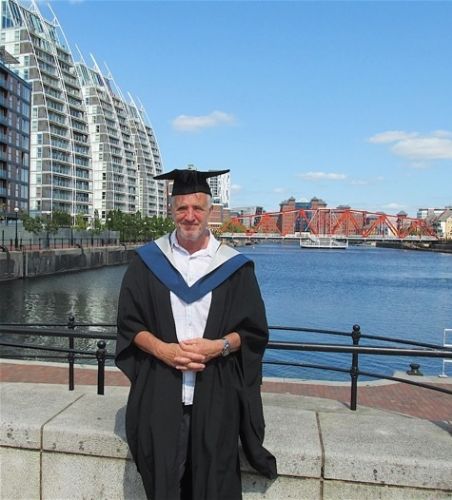
I applied for a course in photography with the University of Salford, was offered a place and, after twelve months I graduated with Honours. Salford University has a lot of local students, unlike some red brick universities, and many have not received a high level of secondary education, come from deprived backgrounds (like myself) and have come as the first of their family to the university through access courses.
It is important that universities such as Salford can continue to provide support to these students so that they can develop their academic and study skills and have an equal chance in the employment market, where students from more affluent backgrounds often have a greater advantage...
"It is a smart use of public money. A student who completes their degree is more likely to go on to succeed in the workplace – and contribute to the economy through higher taxes" - Snowden, 2014*.
I now wanted to take the next step in developing my academic skills, which was a postgraduate degree in Creative Writing but I lacked the skills and confidence to take the leap forward for a Masters Degree. Nevertheless, I applied for this course and was selected for an interview. After a long chat with the course leader, Ursula Hurley, she offered me a place (I must have said something convincing). However, I still had doubts and reservations whether I had taken on too much of a challenge.
Just a few years ago I was tested and diagnosed with severe dyslexia; academic writing was a major problem for me. I applied for support with Student Finance and was awarded the funds for extra help with my dyslexia. I was allocated a coach whose name is 'Anne'. She is well known and respected by both her students and the campus staff. We met for our first session, and she has been a tremendous inspiration in assisting me with my difficulties; she has helped me gain the knowledge and confidence in my writing as a whole.
However, it is my understanding that Government cutbacks on funding for any future students who have the same disabilities as myself (or worse) will make a dramatic impact on their learning abilities, along with any chance of achieving the same sort of higher education that I have undertaken to accomplish my ambitions.
Furthermore, the Government has ensured that it will become very difficult for outside providers like 'Anne' to provide the vital support that is needed. This is because in February this year they introduced a raft of new Level 7 qualifications, to take effect from October 2016.
The majority of study skills coaches do not have this level of qualifications which will prevent them from continuing with their occupation, despite being qualified to post-graduate level and with teaching and disability training certificates. These new rules will not only be a problem for students like myself but will also deprive new students of these experienced coaches.
The Government is insisting that technology and new software will be a substitute for the one-to-one personal tuition that disabled people need, but there's no mention who will be teaching students how to use the equipment.
As a student who has previously used some of the software that was available to me, I had encountered difficulties just trying to understand its fundamental use; never mind the availability of members of staff to explain how these applications work. The software cannot replace human interaction. It can tell you 'what' but cannot explain the `why', and you cannot ask it questions.
*Reference: Snowden, C. (2014): 'Further funding cuts could damage universities'. The Telegraph 24.2.2014




.jpg)


.jpg)
.jpg)
(3).jpeg)
.png)
(1).JPG)
