Salford City Mayor, Ian Stewart, will decide next week whether to go ahead with a Customer Transformation programme which will cost over £3million and lead to the axing of well over 120 staff.
What the Council calls "opportunities for transformational change" have been based on a review by cuts cavorting consultants Price Waterhouse Cooper (PwC), which was paid £78,000 for two months `transformation' work (see here).
From analysis over the summer, the Council reckons between April 2016 and April 2017 it can cull 120 FTE (full time equivalent) jobs out of six hundred it examined, to be followed by the axing of a `conservative' 3% of the remaining 3,600 staff in future years. They will all be replaced by a "digital solution".
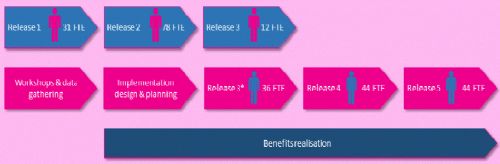
The report being presented to Stewart and his Cabinet next week even has a helpful Benefits Realisation graphic showing phases of staff sackings, with little sad figures inside arrows pointing the way out (see photo).
PwC believes that Salford Council will `save' £1.9million from booting out the first batch of 120 staff, followed by a guesstimate of between £3million and £7million (what's four million quid?) in future years. The report "acknowledges that there is a significant risk associated with the delivery of the savings", or cuts.
Meanwhile the "new digital capabilities" technology will cost an estimated £2.6million with £250,000 new on-going revenue costs. And it could be even more..."It may be that some of these costs, particularly those relating to temporary technical resources, are currently understated", the report notes.
The majority of the expenditure will go on software, hardware and licences to outside companies. This is opposed to investing in human staff who spend their wages within the city, thereby boosting its economy. The Mayor's much vaunted `social value' doesn't appear to be on PwC's radar, or his own for that matter...
At the heart of the transformation programme are "changes to the Council's organisation, staff, working practices, services to customers, and the manner in which customers engage with the Council..."
The way that `customers' engage with the Council will be to "embrace the digital age" – whether they want to or not. In an overload of doublespeak the report states...
"In order to drive efficiencies, citizens and employees will be actively encouraged to
participate in self management and assessment where appropriate. Telephony contact will be limited to specialised needs or to support customers with assisted needs. Face to face contact will be focused around the Gateway centres in a locality based environment with the relevant delivery partners."
In other words, unless residents schlep to the Gateways or are on their last legs there will be no human contact with Council staff. It's the 21st Century Dickension Do It Yourself community, with people fending for themselves against machines in what the Council report calls an "enhanced experience" of "self-service".
Doing everything digitally is fine for those who are au fait with new technology but according to the Council's own figures, only 24% of Salford residents have `high' or `high medium' digital potential – while 74% had `low' or `low medium' digital potential' (2% seem to have got lost completely).
The Council reckons it can `shift' 61% out of those 74% to use digital by basically reducing other channels of communication – even though it states they might not have the `skills, access, motivation or trust' to do this. It leaves 13% of those who have `low digital potential' to rely on the Council's `partners and digital champions' to get by...
.
Having stated these percentages, the analysis gets quickly transformed into a positive spin within the report... "It is expected that approximately 85% of Salford residents will have the digital access, devices, and would be willing to use digital channels if they were easy to use, quick to access and delivered the outcomes they were expecting..."
The result will be a "new customer journey", the Council report concludes – but at the heart of it are, in Council-speak, "potential resource efficiency savings, productivity improvements and asset rationalisation". English translation: `cuts, making remaining staff work harder and closing down more public facing Council offices...'
Expect the Cabinet to approve the proposals next week. Do not expect any of them to understand what they are voting for. Most of the aged ones struggle to use Facebook and Twitter...




.jpg)


.jpg)
.jpg)
(3).jpeg)
.png)
(1).JPG)
