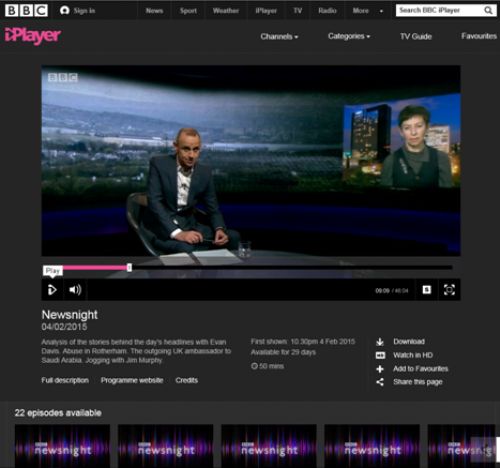
On BBC 2's Newsnight last night (see here), Evan Davis was discussing the shocking report by Louise Casey, into child sexual exploitation in Rotherham, with Sue Berelowitz, Deputy Children's Commissioner...
"How can dysfunction run so deep?" he asked "...was it stupidity, laziness, is it some kind of inertia, ignorance? I just wonder what word captures it for you?"
Without blinking, Sue Berelowitz replied "Shameful and inexcusable" and added that it wasn't unique to Rotherham...
"If it's not unique to Rotherham...what are we meant to think about all the other councils in the country?" asked Davis.
"They ought to be taking a very long cold hard look at themselves" she responded.
In the following article we take a look inside Rotherham Council, via the report, but first it's worth quoting some more of the Newsnight interview...
Evan Davis: "It really is a whole council...One thing that Louise Casey mentions in this report about Rotherham is, not that it was a one party state, it was, very much though, a Labour Council very dominated by one party...there wasn't a huge opposition, that kind of adversarial system where someone sees it as their job to find things wrong with the council...This didn't quite exist and she implies that this perhaps made some of the poor management easier to sustain there. Is there some link do you think between vibrant opposition and two party systems in local government and this kind of poor management?"
Sue Berelowitz: "I can't comment on that but what struck me was the absolute lack of scrutiny and the culture of fear and intimidation in the Council that, in a strange way, mirrored the fear and intimidation that the girls who were victims were subjected to. People were terrified of speaking out, whistleblowers were victimised, they lost their jobs, there was a great deal of bullying taking place from the Leader of the Council – from the top right the way down there was that culture of fear..."
Salford City Council, of course, is no stranger to Child Protection mismanagement, having had OFSTED reports of inadequacy dating back to the fall-out from the Victoria Climbie inquiry in 2003 until resignations of everyone but the politicians and the Chief Executive, Barbara Spicer, from 2009 onwards (see previous Salford Star articles – click here and click here and click here and click here).
However, the criticisms of Rotherham Council contained within Louise Casey's Report of Inspection of Rotherham Metropolitan Borough Council were based largely around the culture of the Council itself, which allowed such horrific events to unfold. The Salford Star would argue that Salford Council, under the `leadership' of elected City Mayor Ian Stewart, is veering towards such conditions, again...
We shall let the report speak for itself and invite councillors, community groups and residents to draw their own conclusions...
On Leadership and Governance
* the inability of the political leadership to hold officers to account and for senior officers to provide appropriate information to Members; the inability of all Members to properly represent the interests of local people and businesses, particularly by failing to effectively challenge to ensure improvements in outcomes
Failure to Listen, Learn, Challenge and Improve
*Too often, the Council has been content to settle for 'adequate' where in reality this meant residents, including vulnerable children and young people, were not being served well. The Council's response has been to develop voluminous action plans and monitoring reports. But there has also been a propensity for plans to slip or be ignored and not be implemented at all, while monitoring reports are obscure and over positive.
*Inspectors saw regular reports to the Cabinet and Scrutiny committees, but not the effective challenge we would expect from elected Members. The notion of challenge has been misunderstood and misinterpreted as bullish questioning. Challenge means setting aspirational targets, knowing how far to stretch the organisation, asking searching questions, drilling down into information and data, ensuring targets are kept to and agreed actions implemented. It also means recognising organisational inertia and doing something about it; identifying when people are struggling, finding out why and getting alongside them, overcoming barriers and working out solutions.
On the Deputy Leader... We heard that some Members and officers felt intimidated by him and that he had made threats
On Management...
Inspectors found that the conduct of some senior officers and leading Members was, at times, inappropriate but went unchallenged. People claimed to have been shouted down, silenced and intimidated. This undoubtedly had wider implications in terms of what was seen as acceptable in Rotherham...
inspectors found an organisation which is not corporate and which operates in silos...The culture of 'keeping your head down,' of cover-up, and the level of anxiety amongst those interviewed was above what might normally be expected
There needs to be a shared ethos that no department or team can regard itself as serving its community well if the Council is failing its most vulnerable people.
Reports are Poor; Member Challenge is Ineffective
*We saw some evidence that some officers sought to keep Members at arms-length, and direct them away from concerns. Certainly, officer reports did not always present the facts in an easily accessible way, sometimes failed to set out the full position and at times could be seen as misleading. We considered that Members did not ask probing questions to get underneath the skin of reports and data.
On Scrutiny
*...it is not clear how effective it has been in holding Cabinet Members and senior officers to account for their individual performance and decision-making. Inspectors could not find much evidence of how scrutiny had changed practice or policy making.
Senior officers described a difficult relationship with overview and scrutiny, a lack of detailed information to back benchers, and an in-built self-regulation of the process. Senior Members admitted that Cabinet has been unprepared to release information to scrutiny. At one point there was an instruction – lasting five months - that no information could be given to scrutiny without the agreement of the Lead Member.
"The Cabinet had failed in not scrutinising themselves enough" a leading Labour Councillor
*Inspectors concluded that overview and scrutiny had been deliberately weakened and under-valued. The structures and processes look superficially adequate, but the culture has been one where challenge and scrutiny were not welcome.
"People did feel fearful of attending the scrutiny board and intimidated in Council meetings" a senior officer
*.... not enough Members really know how to get underneath information presented by officers, and the organisation has not properly resourced and facilitated effective scrutiny. It was generally acknowledged that the scrutiny team was small and disconnected from the Senior Leadership Team.
The fact that Members' services are provided informally and are in the gift of each director leaves the Member position weak and further discourages effective day to day challenge. Clearly, if scrutiny is unwelcome and only funded at the behest of those being scrutinised, it is unlikely to be effective.
On the Opposition...Whilst the opposition in Rotherham is small, we saw limited evidence of them raising concerns and putting pressure on the leadership
On the Leader of the Council...
The Leader may appoint Cabinet advisors who receive a special responsibility allowance. On average up to three such appointments have been made for each Cabinet role. Large numbers of Members are therefore receiving an allowance...Although there is nothing improper about Rotherham's arrangements, they have led to a perception of 'grace and favour' and patronage including among leading Members.
On the Monitoring Officer
*The Monitoring Officer has a specific duty to ensure that the Council, its officers and its elected Members maintain the highest standard of conduct in all they do. The Monitoring Officer has a duty to write a report if he/she considers that any proposal, decision, or omission made by, or on behalf of the Council, is illegal or would be illegal. This is not a duty to write a report every time an allegation of illegality is made, but only if in his/her personal opinion that it did, or will occur. Inspectors were not made aware of any Monitoring Officer reports.
There is a culture where the opportunities to identify potential problems of
governance or adherence to the code of conduct are missed. Inspectors found a general lack of professional curiosity or tenacity to grasp issues. For instance, we found that while there is a gifts and hospitality book for Members, no-one has the responsibility for taking an overview of the content and checking compliance. Therefore it is not routinely done.
On the Bottom Line...
*...the budget process has been led by finance. All departments were asked to find a quota of savings, with some protection for frontline services. This approach has delivered the bottom line, but with serious consequences. For example, some services no longer have the capacity to function effectively. We were particularly concerned about the level of funding for central regulatory functions and those which will drive transformation, like legal services, organisational development, strategy, and resources to ensure community cohesion.
On Impropriety
...Rotherham is rife with rumours about impropriety which creates an unhealthy climate of mistrust. External audit should be directed to look at areas where persistent speculation arises in order to restore public confidence or tackle the weaknesses identified, or both.
As if to underline the arrogance of Rotherham Council, there's a paragraph in the Casey inquiry which also deserves a mention...
A report to the Audit Committee on 17th September 2014 identifies the Jay report as the second highest risk facing the Council. The risk is described as follows: 'Major reputation damage and loss of confidence in the Council; demoralising impact on employees; potential financial claims; potential impact on inward investment; short and medium term disruption/distraction from services; subsequent OFSTED and corporate governance inspections.' It does not set out what it will do to mitigate such risks and indeed, these risks are now very real issues.
There is nothing about the risk to children.
The risk of services continuing to fail children should have been the Council's highest priority. But it was not. This goes to the heart of the culture of the Council and what senior leaders think really matters...
How relevant is all this to Salford City Council?
See previous Salford Star articles...
Nine Thousand Salford People Gagged – click here
Salford Mayor Brings China To The Irwell – click here
Massive Public Money Scandal Rocks Salford Council – click here
`Paperwork Error' Of Salford Mayor – click here
Council Smears Against Salford Star `Didn't Breach Standards Code' says, er Salford Council – click here
China On The Irwell – click here
Councils "ought to be taking a very long cold hard look at themselves"...




.jpg)


.jpg)
.jpg)
(3).jpeg)
.png)
(1).JPG)
