HOW THE TREE OF KNOWLEDGED WAS SAVED
It was on the morning of the 3rd August that the Salford Star first heard via the Tiles and Architectural Ceramics Society (TACS) of plans to demolish the Tree of Knowledge - a huge stunning ceramic mural sited on the wall of the old Castle Irwell School near the Cromwell roundabout in Charlestown.
We went down to the site and were told that it was due to be demolished, along with the rest of the building, the following day. By 11am we had the story and photos on the website, and sent the link to thousands of our supporters via Facebook, Twitter and our e-mailing list. We urged them to e-mail John Merry, Leader of Salford Council, relaying their disgust at this act of cultural vandalism – only in Salford could the Tree of Knowledge be demolished!
Literally within minutes of the story appearing on the website, comments and e-mails began flooding in showing the strength of community support for this priceless piece of our city's heritage. By 5pm that day Salford Council had backed down, the demolition had been halted and Salford Council Leader, John Merry confirmed that "demolition has been stopped and I am now looking into the matter with a view to preserving the mural if possible..."
Later that evening we received an e-mail from TACS saying that Alan Boyson, creator of the Tree of Knowledge, was `chuffed' with the campaign; and that advisors from English Heritage were to visit the site to see if the artwork could be listed, after being impressed by the level of community support for the mural. TACS was now working with the Council on the possibility of salvaging the Tree of Knowledge.
Meanwhile, all the e–mails and comments the Salford Star received were passed onto English Heritage, which subsequently passed them on to the Government, recommending that the Tree of Knowledge be protected. Last night we heard that the Government agreed and has listed the Tree of Knowledge as Grade II.
Make no mistake about it – without Salford's community protesting about the sculpture's demolition so quickly and so articulately, this "rare surviving example of a bespoke 1960s ceramic mural" with a "high level of aesthetic and artistic quality" would now be rubble…
Instead, the Department of Culture Media and Sport listed the Tree of Knowledge as `Blandford Road – Mural at former Cromwell Secondary School II' and gave it a catalogue number 507448.
Now we are urging Salford's community to ensure that the Tree of Knowledge is looked after and await a comment from Salford City Council on its plans for the listed artwork…
`A National Precedent Has Been Set'…
Read the full press release issued by the Tiles and Architectural Ceramics Society today…
The Tiles and Architectural Ceramics Society (TACS) is delighted at the
government's decision to list Salford's Tree of Knowledge at Grade II
because of its special architectural or historic interest.
Ben Bradshaw, the Secretary of State for Culture, Media & Sport has
recognised the national importance of the 1962 sculptural ceramic mural
by listing the mural for these principal reasons:
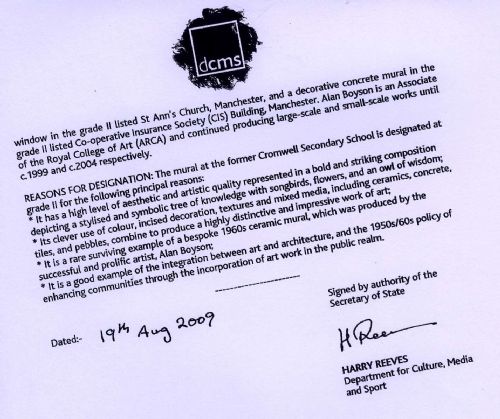
• It has a high level of aesthetic and artistic quality represented in a bold
and striking composition depicting a stylised and symbolic tree of
knowledge with songbirds , and an owl of wisdom;
• Its clever of colour, incised decoration, textures and mixed media,
including ceramics, concrete, tiles and pebbles, combine to produce a
highly distinctive and impressive work of art;
• It is a rare surviving example of a bespoke 1960s ceramic mural which
was produced by the successful and prolific artist, Alan Boyson;
• It is a good example of the integration between art and architecture, and
the 1950s/60s policy of enhancing communities through the incorporation
of public art in the public realm.
TACS wishes to thank English Heritage and the DCMS for their prompt
action in processing the society's listing request of 3 August. It has taken
just 16 days to list this post-war mural.
If it not been for the Salford Star's readers protest against the imminent
thoughtless demolition of the Tree of Knowledge, Salford Council would
have crushed the mural within hours. Thanks to the Salford Star and its
readers. Thanks also to Salford Council for acting quickly once the
significance of the mural was drawn to the council leader's attention.
Chris Marsden, Conservation Secretary of TACS said "With public pressure
leading to the halting of demolition, the listing process has been allowed to
go through and has resulted in a degree of protection. That is great news.
However there will be change. The Salford Council has plans to clear the
site and in the long-term develop playing fields. It is important that a
watch be kept on the decision process by Salford residents and groups
so that any proposal affecting the mural is made in the open and with
public support".
Sadly, Britain's fine stock of murals is not always cherished. As changing
fashions, weather, vandalism and commercial pressures take their toll.
Some have been demolished or even buried, as in the shocking case of
Plymouth's Armada Way subway mural (1987-8, Edward Pond and
Kenneth Clark), filled in by the local council in 2004. Most recently, in
autumn 2008, the magnificent mosaic 'An Eye for the People' by Ray
Howard-Jones (1903-96) which had decorated Cardiff's Thomson House
since 1959 was unceremoniously reduced to rubble along with the rest of
the building.
Chris Marsden said "Salford will set a national precedent. Here the mural
was listed whilst the building it is part of is without significance. The
mural is now recognised as being of Salford and of national importance.
Public art murals can no longer be dismissed as incidental when they have
the qualities of The Tree of Knowledge.
"TACS will continue to research the Tree of Knowledge and its related
works and will work with Salford Council and others to secure the best
possible outcome for this amazing mural".
Read The English Heritage History of The Tree of Knowledge…
Cromwell Secondary School for Girls opened in 1962. The school was designed by Cruickshank & Seward of Manchester, and constructed by W. Fearnley & Sons. The architects commissioned the artist, Alan Boyson (b.1930), to produce a mural for the exterior of the school and a ceramic tiled wall for the entrance hall, at a cost of £400. The ceramic tiled wall has since been lost. Included in the mural design were water-worn pebbles from Ice-Age deposits and historic ceramic fragments that were found on the site prior to the school's construction. The school later changed names and eventually became part of Salford University, which moved out in c.2008.
Alan Boyson trained at the Manchester Regional School of Art from 1950-4 under the ceramicist Lester Campion, and subsequently at the Royal College of Art from 1954-7 under the tutorage of Robert Baker, Professor of Ceramics. After his studies, Boyson lectured in the Ceramics Department at Wolverhampton School of Art from c.1959-61, and whilst there, he established his own studio and began to produce studio work and small commissions.
The Cromwell School work was the first of many large commissions for Boyson, who worked all over the country. It is not known how many of Boyson's works survive, but some of his works included the 'Three Ships' mural on the former Co-operative building, Hull (locally listed); a ceramic tiled wall and two concrete screens at another school in Salford; a ceramic memorial at the Birmingham Oratory; a sculptured aluminium banking hall ceiling at the Bank of England, Leeds; stainless steel piece in the NatWest Tower, London (late 1970s); a glass screen and decorative ceiling in the Halifax Building Society HQ, Halifax (1970s).
It is known that two of Boyson's works survive in listed buildings: an abstract Art Deco-style memorial window in the grade II listed St Ann's Church, Manchester, and a decorative concrete mural in the grade II listed Co-Operative Insurance Society (CIS) Building, Manchester. Alan Boyson is an Associate of the Royal College of Art (ARCA) and continued producing large-scale and small-scale works until c.1999 and c.2004 respectively.


.jpg)
.JPG)
.JPG)
.JPG)


.jpg)


.jpg)
.jpg)
(3).jpeg)
.png)
(1).JPG)
