Since L.S. Lowry became cool and hip, every town, village and dwelling with a claim — no matter how small — to influencing or gracing his talents have latched on to the tourist potential. Berwick-Upon-Tweed, I learned this weekend, has the Lowry trail. Apparently, Laurence visited Berwick numerous times in 1930s and said trail plots the main areas which have a lineage to his some of his paintings. Honestly speaking, it’s quite a picturesque place; but it makes you think… one day you could be using a toilet in Penzance unaware of the blue plaque reading: ‘Where L.S. Lowry once dropped his guts after a meal of tripe and rollmops’. What a picture that conjures up…
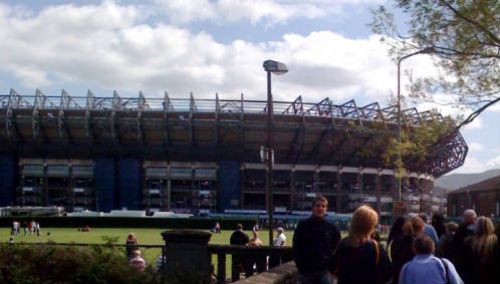
I mention Berwick because last weekend a few of us were in the area for ‘Murrayfield Magic’ — a contrived event where the whole of Super League dredged up to Scotland for an entire round of fixtures: three matches on Saturday and four on Sunday. Salford City Reds happened to be first up at 3pm, against Harlequins (from that London).
It’s not the first time rugby league has graced the famous Scottish home of its rival code. The 2000 Rugby League Challenge Cup final was held at a rain sodden Murrayfield, where Bradford Bulls pipped Leeds Rhinos 24–18. The match that is surely best remembered for Nathan McAvoy’s uncharacteristically sublime chip over Iestyn Harris’s head, leading onto one of the great Cup final tries, and scored by a Salford lad no less!
On the day the weather looked fine, with plenty of sun and blue sky; perfect t-shirt weather. What a classic Scottish schoolboy error, you could tell the southerners were in town. It was deceptively chilly, and blowy. In other words, it was Scotland, and it being Scotland, it wasn’t long before seeing the token foreigner wearing the novelty jock hat and ginger wig. I’m sure that gag endeared him to the locals.
With plenty of fans sauntering towards the boozers, the city centre was awash with the united colours of Super League. This is still one of rugby league’s strengths — that opposing fans can have a few beers together without macho tribalism getting in the way. Not until the game anyway. It’s a cliché but largely still true. We noticed a fair amount of Reds grabbing the Middlesborough vs. United game on the big screen, before legging it to Murrayfield to make kick-off.
The Reds started off well, unphased by the unfamiliar surroundings and size of the venue. Indeed, the game was nip and tuck for most of the first half, which ended in favour of Harlequins 12–10. The result felt in the balance and we were in with a real shout of taking the spoils; which was in marked contrast to a couple of months ago, where the Quins played the Reds completely off the park at The Willows. Surely (or hopefully) it’s a measure of how Salford have improved as the Super League season has progressed.
The second half, however, proved be a damp squib…well, for the Salfordian contingent. The Reds couldn’t keep pace with Harlequins as they did in the first 40 minutes. Despite a desperate, failed effort to score in the corner by Robbie Paul — playing his 400th club game in British RL — Salford didn’t do enough to try and win the game. A ropey no-decision by the referee, where he missed a clear knock, ending in a try to Harlequins, sealed the game’s fate; Salford found themselves 14 points down with not enough time left to make up the deficit.
This was the point where Salford decided to throw caution to the wind. With the skilled urgency of the Harlem Globetrotters tossing about a hot potato filled with Semtex, the Reds managed to score a quick consolation try. Rather than having us jump for joy, it pissed everyone off. Why didn’t they try this 15 minutes ago when the game was still in the balance? It was a classic case of too little, too late. The final score was another respectable loss, 16–24. Though what grates is that Harlequins were there for the taking and Salford just couldn’t raise their game to grasp the chance of a precious two points.
And that was it, back to Edinburgh city centre, where we spoke to a couple of familiar faces (fellas may I add) who paid seventy-odd quid the train from Manchester, only to give the game a miss and go shopping! It’s fair to say that plenty of Salford fans left after the first game (a very cheap ticket entitles you to see all three matches on the day) which makes you question the validity of the event as a whole.
These Magic weekenders began a few years ago when the Rugby Football League staged the first of such at the Millennium Stadium in Cardiff, presumably as a favour of thanks for hosting the Challenge Cup final during the period when Wembley was out-of-action. Thus, the governing body have continued it annually. One of the supposed by-products of the hosting the Magic events is that it helps to attract supporters from pastures new, given that, up to now, they’ve all been hosted outside the so-called rugby league heartlands.
The first couple were held in Wales, a precursor, perhaps a contributor, to conception of a Welsh team in Super League (in Celtic Crusaders) before the third such staging in Scotland last weekend. Yet there’s little evidence to support that the locals, or even suburbanites, are interested. Take this year’s Magic weekend for example. There was no noticeable sign of promotion in Edinburgh leading up to the event (as reliably told by someone who lives there). National TV didn’t pick up on it either; BBC Breakfast sports news on the day didn’t even mention it, and they even covered a novelty piece about the new ‘craze’ of boxing chess, repeatedly on-the-hour; probably some tawdry reference to the Hatton vs. Pacquiao mega bout the following morning. And although these weekenders are contrived, there are real competition points at stake; it’s the real deal.
There’s nothing to suggest, given the attendance figures for the event (60,000 over two days, with an expected amount of duplicates within that figure), that the Magic weekend is anything more than shifting the regular rugby league crowd hundreds of miles up the road. That’s not particularly a bad thing. It was my first visit to Edinburgh, and I mightn’t have visited otherwise. Also, you have to credit the RFL for doing something different which is, perhaps, something envied by other sports; but considering there would have been many families at the event, is the relative cost to the supporter — for a game which is still entrenched in, shall we say, less well-off areas — offset by the benefits the Magic weekend brings? I’m not entirely sure.




.jpg)


.jpg)
.jpg)
(3).jpeg)
.png)
(1).JPG)
