Go into The Cornerstone on the corner of Langworthy Road and Liverpool Street, and up the stairs to the Lost Salford Districts exhibition, where a whole stretch of wall unfolds with maps, and lists and lists and lists of demolished streets in Central Salford...twenty five sheets of paper detailing 1,230 streets demolished since 1955...
...And then, go to the far wall and check a few sheets of paper listing only 124 streets in Salford that have survived...one left in Greengate, one left in Brindle Heath, three in Charlestown, seven in Pendleton...and only five in Lower Broughton out of two hundred.
"Over an eighty year period there's only ten per cent of streets left" says Lawrence Cassidy, of the Retracing Salford project which has been documenting disappeared streets for almost ten years, reclaiming and exhibiting many of the lost street signs in the process.
"It's the first time we've built up a comprehensive picture of the streets" he explains "It's amazing...it's wide-scale devastation isn't it? We're trying to get an overall picture of the architectural legacy that is left of the city, but while the city has been celebrated as an industrial heartland there's only ten per cent of people's heritage left. While some places have survived and been lavished with funding these have just disappeared."
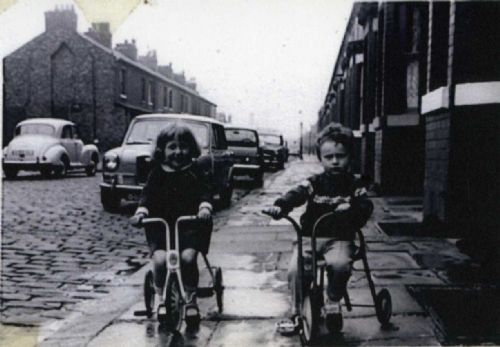
Salford people are invited to bring photos of themselves in the lost streets, write on the lists where they lived, which year their home was demolished and where they moved to. Because it's not just the streets that have been cleansed, it's the people who lived in them too...
"We know there's been two or three rounds of clearance and each time there's an ever decreasing number of working class people in the city" says Lawrence "In Broughton there were 18,500 people, now there's around 2,500. It's being re-populated by apartments and new builds that contain ten per cent or less social housing - but without getting into that we're just doing a straight heritage study of the legacy of what's left, and it's ten per cent. If it wasn't including Langworthy it would be three or five per cent because Langworthy has got around 100 streets left."
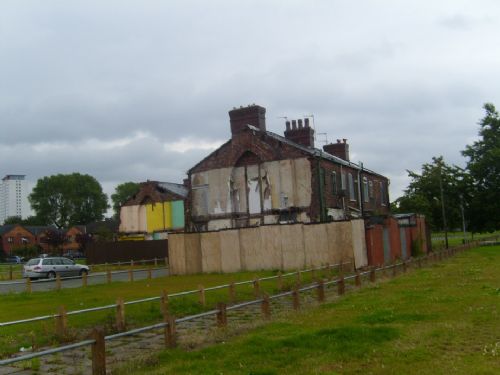
It's apt that the exhibition is being held at the Cornerstone because literally around the corner, the houses around Athole Street are tinned up awaiting demolition as part of the Pendleton Together PFI scheme which is seeing 885 affordable homes being bulldozed and only 500 `affordable' houses out of 1,500 new properties being built. It's no coincidence that Pendleton borders on Media City, Salford University, Chapel Street etc.
The cleansing that the Lost Salford Districts graphically illustrates was explained over 140 years ago by world famous economist, philosopher and revolutionary Frederick Engels, who worked at his father's Victoria Mill in Weaste, less than a mile away from the Cornerstone. It's worth quoting Engels in length to explain everything that's going off in Central Salford...
"The growth of the big modern cities gives the land in certain areas, particularly in those which are centrally situated, an artificial and colossally increasing value" he wrote in The Housing Question in 1872 "The buildings erected on these areas depress this value instead of increasing it, because they no longer correspond to the changed circumstances. They are pulled down and replaced by others. This takes place above all with the workers' houses which are situated centrally and whose rents...can never increase above a certain maximum.
"The result is that workers are forced out of the centre of towns towards the outskirts; that workers' dwellings...become rare and expensive and often altogether unobtainable" he adds "For under these circumstances the building industry, which is offered a much better field for speculation by more expensive houses, builds workers' dwellings only by way of exception...They will provide new dwellings for hardly more than a quarter of the workers actually evicted by the building operations."
Engels reckoned just twenty five per cent of the working class would be left, Lawrence Cassidy reckons it's "less than twenty per cent" after the new housing and apartments have gone up, and "implantation" of a new population has happened.
Mention Ordsall, across the road from Salford Quays... "It's a long process of attrition" he says. Mention Broughton, where his own family home was bulldozed, and Lawrence just holds his hands out in disbelief...
"We're trying to find out where people have gone from those districts" he says "So you can come and write on the sheets what district you lived in and where you went, it's to get a picture of dispersal really."
Unfortunately, Lost Salford Districts is an ongoing saga but this important exhibition has to be seen to experience the scale of what Lawrence calls the "devastation"...
LOST SALFORD DISTRICTS until Friday 28th November
Langworthy Cornerstone Community Centre
451 Liverpool Street M6 5QQ
The exhibition is open Monday to Friday 9am – 8pm
Lawrence Cassidy and his team will be there every Thursday in November 3-4pm to talk about the exhibition
For further details contact Lawrence@streetsmuseum.co.uk
www.streetsmuseum.co.uk
See also Facebook page Salford Streets-Museum


.JPG)
.JPG)
.JPG)
.JPG)
.JPG)
.JPG)
.JPG)
.JPG)
(2).JPG)
.jpg)
.jpg)
.jpg)


.jpg)


.jpg)
.jpg)
(3).jpeg)
.png)
(1).JPG)
