While a zillion people crossed their legs and watched a zillion boats freeze on the Thames, in Salford the commemorative plaque to the Chartists, who met on Kersal Moor in the 1800s to demand democracy, was being re-positioned and unveiled in what was called `The Other People's Jubilee'.
The Chartists first met on Kersal Moor Racecourse in 1838 when hundreds of thousands of people marched from all over the North West to demand the acceptance by Parliament of a six point `charter' - the vote `for every man over 21', secret ballots in elections, the abolition of property qualifications for MPs so the poor could stand for election, payments for MPs so anyone could stand and not starve, equal electoral districts and annual Parliament to put a check on the bribery of MPs. All but the last demand have since been met.
This massive rally was one of the biggest in the country and led to the birth of democracy, not only in Britain but throughout the world. After years of campaigning for the Chartists to be recognised on the Moor, a plaque was finally unveiled two years ago (see here) but it recently got vandalised. Now restored by Steve Higham, from the Salford ranger team, the plaque and its plinth has been moved to the edge of Kersal Moor (on Moor Lane) where more people can see and safeguard it.
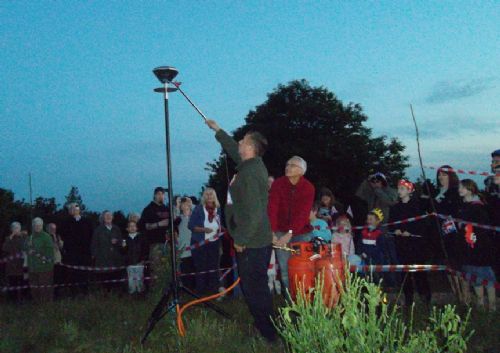
The re-unveiling of the Chartist reminder was in sharp contrast to the pomp of the Queen's Jubilee celebrations in London, although, in the evening, many people turned out on the Moor to see the Jubilee beacon being lit by the older generation, represented by Ellen Keepe, and the younger generation, represented by seven year old Heather Harmer.
While Besses Brass Band accompanied the ceremony, free cakes and wine were served to everyone who came, as Friends of Kersal Moor continued their great work of bringing this historic Salford site back to life…
"The two Jubilees held on Kersal Moor on June 4th were successful for different people and in different ways" explains Alice Searle of Friends of Kersal Moor "The Chartist Jubilee was attended by people who care about the history of the workers who fought for justice. The evening Jubilee remembered a different history.
"But everybody said 'What a great community event' it was" she adds "That to me was what mattered. It was not nobility but ordinary folk enjoying each other's company in a lovely place. I like to think that the Beacon shone for them."


.JPG)
.JPG)
.JPG)
.JPG)
.JPG)
.JPG)
(1).JPG)


.jpg)


.jpg)
.jpg)
(3).jpeg)
.png)
(1).JPG)
